Depends where you are and what you’re doing, but learning how to sail or sailing in a club is right around the corner!
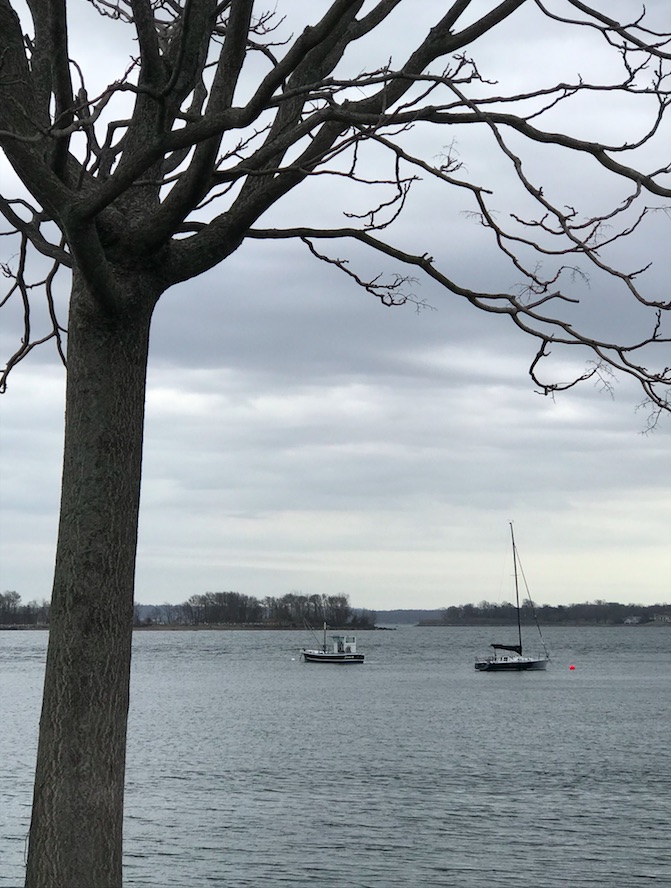
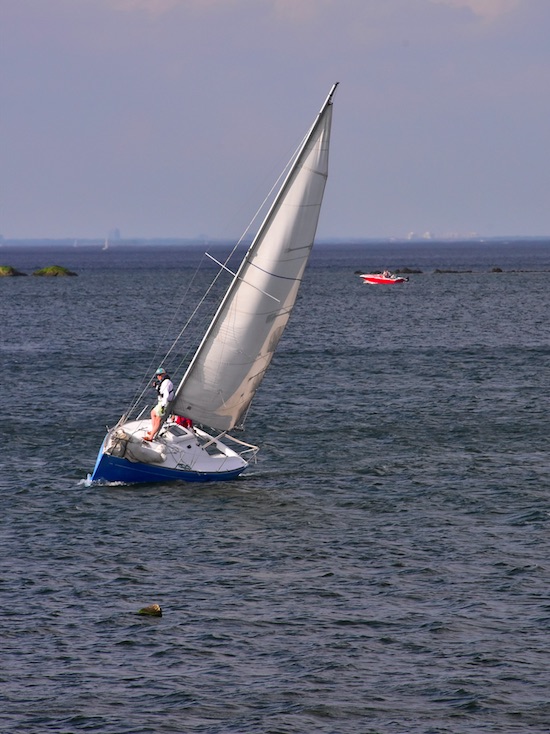
IN THAT PIC: old and new, workboat and racing sloop, City Island Harbor. Late March. It’s ON!
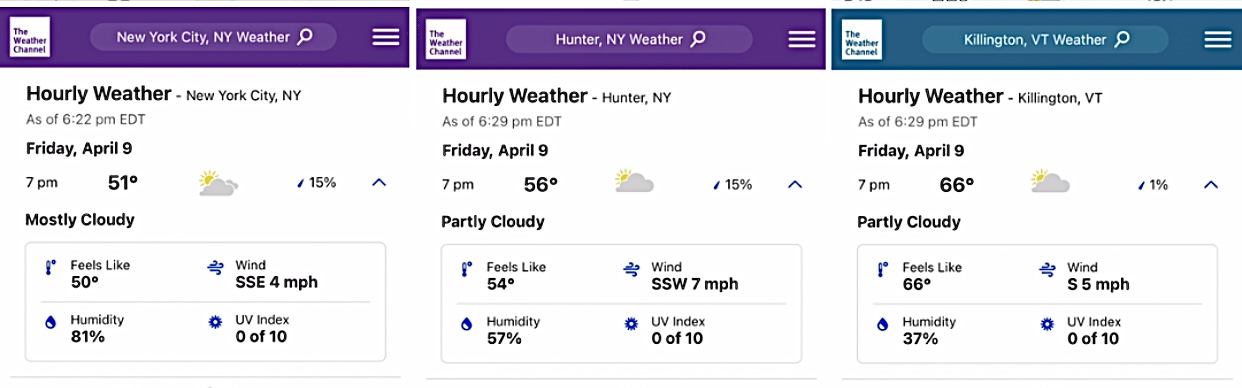
So, yesterday evening, I was double checking the temps and precips at several spots to juggle competing concerns… fleet prep and launching, and also a potential last shot at some snowboarding. Interesting stuff! Had to double check to be sure… don’t take my word for it!
Yup… we are totally inverted temp-wise. Partly sunny everywhere, although it had just rained a bit in NYC.
NYC: 51°
Hunter NY (Catskill Mountains): 56° (nb: it was 59 shortly before I screen shot these)
Killington, Vermont (about 1/3 of the way up to Canada): 66° (and yeah, it was at least 67 shortly before)
This weekend is the last of the season for Hunter and Windham in the Catskills. Stratton in Vermont hasn’t announced a closing date yet, but they’re getting kinda close. Magic is already done. But Killington? 83 trails open yesterday – a few more than just a few days ago due to moving snow around and grooming. With a little luck, I might still get up for a day and a half or so without neglecting anything here in the colder south!
No…. not cherry blossoms, but who’s counting? Still beautiful. If anyone knows what they are, prove you read this and chime in! Riverside Park, April 8.
The cherry blossoms are popping. That means the fishing picks up, and it means that sailing weather gets more consistent soon. Sailing Club sessions are available almost as soon as we splash the first boat! Classes start in a little over a week, with Start BareboatingSM (ASA 104) on the 17th. Start (ASA 101, learn to sail) begins May 1. We used to always start in April with that: mid month. We took some bruises with weather delays, but it worked. Until, of course, it didn’t.
Global warming and related climate/weather changes have made April too iffy to jiffy reef (reduce sail) and suit up/show up for April beginner lessons. It’s not so much a matter of cold; that can factor in, of course, but most students who come for lessons have done some skiing or snowboarding, and many are regulars. They have the gear. But, too much wind is counterproductive or even unsafe for beginners. Add cold and rain, and it’s freakin miserable sitting in a boat with cold wet hands on ropes and steering sticks (tillers). Plus, hard to keep a dry butt.
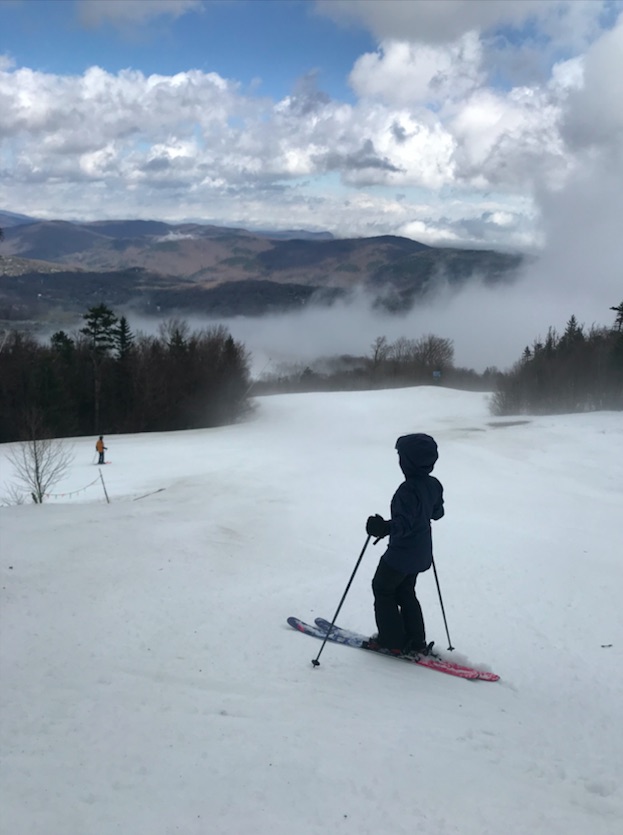
Late March, Killington Resort, Vermont. We had fog, wind, rain, and thunderstorms on and off all day. The next day was bluebird by comparison! And, most of the mountain was still open. As of this captioning, they have 79 trails open (yesterday ended with 83). That’s still more than 50% of Killington minus Pico!
June is arguably the single best month for beginners to learn to sail. It averages out two key variables: volatile weather, and time to continue practicing and enjoying as the season goes. Having said that, people learn successfully throughout the boating season. Any month can have a few stinker days that aren’t productive enough, and lead to a make-good. Our courses aren’t over until they are – when students have the skills they need to go skipper the same boat they just learned on! Otherwise, what’s the point?
THEY DID! The couple that learns together… keeps sailing together, if they do it right the first time. With us, you do. JP and Liz, aboard Kilroy (our Pearson 10M), dusk on a fall day on City Island Harbor, gateway to Long Island Sound.
Or, lose their fishing rod… or, catch COVID. But we can all prepare well to avoid or mitigate any of that. We mitigate every time you come to learn how to sail with us.
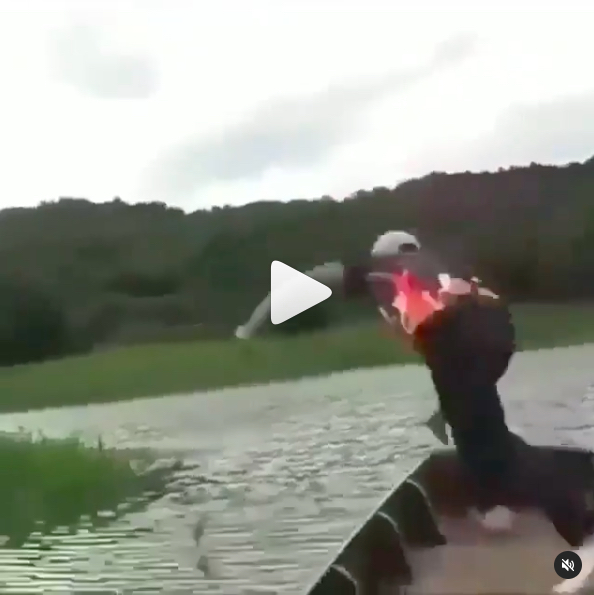
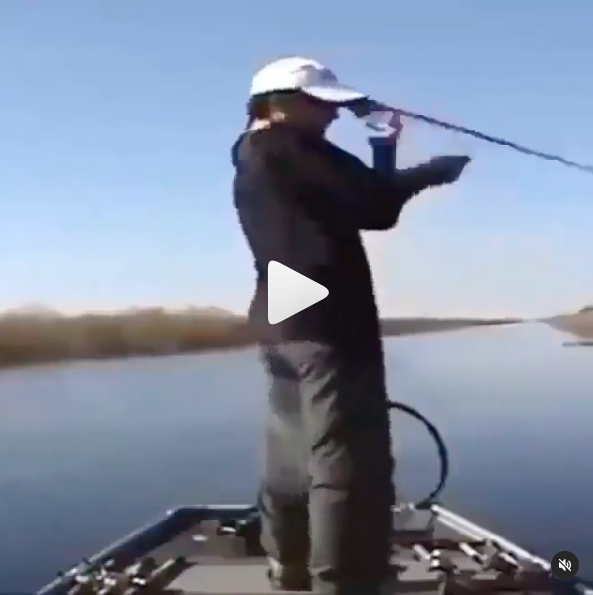
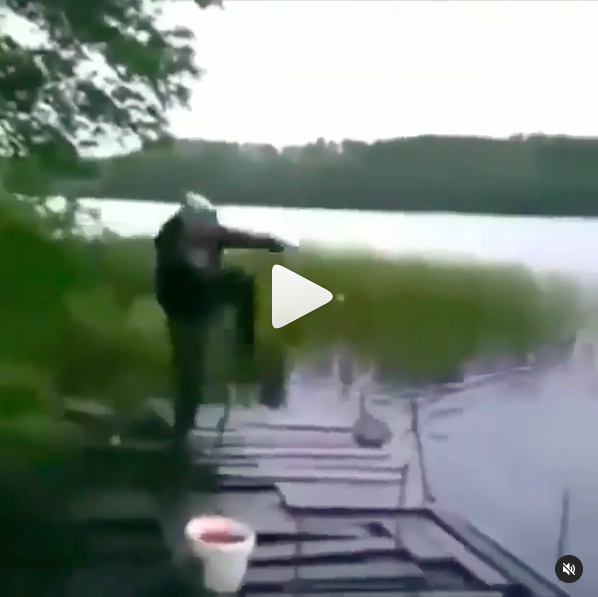
The inspiration for this post? A recent funny a/f Instagram clip we came across and reposted. Fishing fails. Four different clips of people failing spectacularly at fishing.
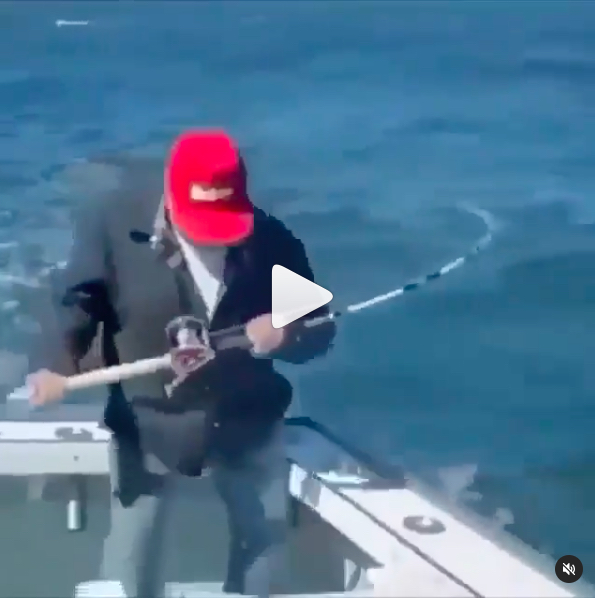
This isn’t a MAGA joke; it’s a guy trying to manage his tackle – a trolling rig on a moving motorboat, and he’s got a fish on to boot. Looks awkward, right? It gets worse! Pic is a link to the clip.
I have free license to laugh. I’ve lost rigs to hooked fish twice in my lifetime, and came damn close another time. I’ve paid my dues; I know what can happen.
The first time was in my teens. The fam was in the BVI (Virgin Islands), and I was at least as interested in fishing as sailing at the time. I caught some live bait that afternoon and kept the little fish alive in a bucket pending live lining for something larger off the dock that night. Lo and behold, some other kids down there had the same idea and we were all tossing our bait to the shadow line off the dock to see what came by. It was quiet. One kid was having trouble with his tackle, so I offered to help. I put my rod down and went to help. As I walked back, I saw my pole torpedo off the dock out onto the surface of the water, where it didn’t sink – but actually glide along teasingly for a moment, leaving s little wake. Then it suddenly shot off into the night so fast it just disappeared. Gone. Done. Had to laugh; I had that kind of humor even back then.
Doesn’t look like he’s heading in the right direction, do it? AND… he’s not wearing a PFD! Didn’t EXPECT to go overboard! Pic is link to clip, of course.
And, no… no one actually EXPECTS to fall overboard. But we do sometimes, and that’s why we wear life jackets or PFD’s. During our Start SailingSM courses (learn to sail / ASA 101), students always wear PFD’s. What if it’s hot out, light wind, warm water, and everyone can swim? You STILL wear them. We invest in high-quality automatic inflatable jacket with manual overrides. That way, you don’t even know you’re wearing them.
We sail in very controlled settings, with an eye on the sky as well as the radar and weather apps. We don’t take you out when bad weather is approaching, and we get off the water before conditions deteriorate if we’re the slightest bit concerned. But, developing good habits during class carries over into the future of your sailing. Hard to get separated from the boat if you’re tethered to it; hard to drown if you’re wearing a personal flotation device.
Dinger! Upside his head. What led to that, and what comes next? Click on pic for the clip!
The second time I lost a rig overboard? I was in my 30’s. I was on a private fishing charter with a friend from my saltwater fly fishing club, the Salty Flyrodders of New York. It was out of Montauk, and we were on a Boston Whaler Outrage (large rig; probably over 20′). Captain Ken Turco (RIP) was putting my friend Mark and me on the fish. It was wall to wall false albacore, and it was easy to hook up. They were bombing small bait on the surface, so there was really no surprise about what would happen: see fish, drive over to fish, don’t actually run through the fish, cast to the fish, hook and fight the fish.
So, we did. Fish on with each cast. We decided to experiment with how quickly we could bring each one to the boat to release it and catch another. The quicker it’s done, the better it is for the fish, as stress and oxygen debt can later kill a fish that actually swims away apparently unharmed. So, we started tightening down our drags more and more with each fish released. (Drag on a fishing reel is the braking mechanism that allows controlled slippage of the line from the reel so a fish doesn’t simply snap the line or the rod.)
False albacore are small tuna. Small, but strong. They do one thing when hooked: swim away fast and far. Hence, proper drag tension. We were getting tired fighting one after another with tight drags. And, my hands were very stiff and tired. And so, after hooking the umpteenth fish, I bobbled the rod. And almost caught it; but not quite… and it bounced off the gunwhale and into the water. I hesitated; could have jumped in and grabbed at it before it sank. But that’s not an easy reflex. I lost the opportunity, and the rod.
I just stood there for a moment. Ken and Mark eventully looked around to see how I was faring and to make sure our respective fish didn’t cross lines and tangle. They saw I had no rod. “No…” said Mark. Ken was slack jawed. I said nothing. I turned to Ken’s rod rack, grabbed one, started stripping line off, and was soon onto another fish.
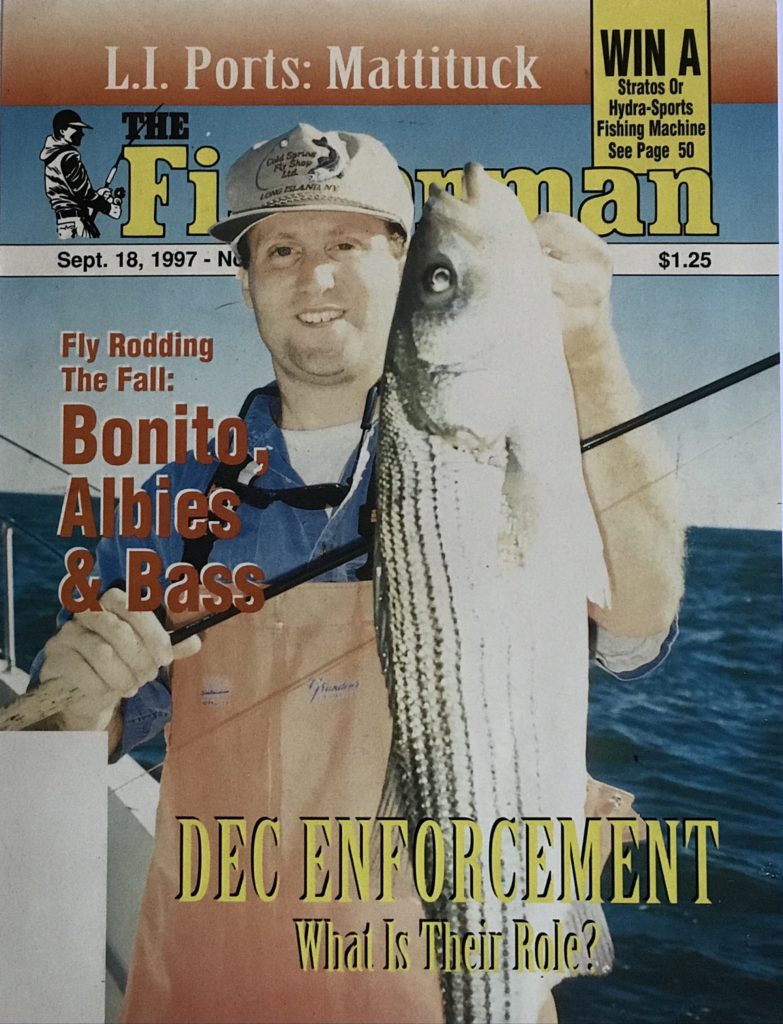
Awhile later, I almost dropped THAT rod as well. That one I would have had to pay for. That’s how non-stop the action was with albacore, bluefish, and even a nice striped bass for me to score a ‘northeast slam.’ Made the cover of the following week’s Fisherman magazine, Long Island/Metro NY edition, for which I wrote a column and some articles at the time.
OUR FEARLESS LEADER! Captain Stephen Glenn Card with a decent striped bass he caught back in ’97 on a fly rod, after a slew of false albacore and bluefish. All fish were released to hopefully keep swimming, eating, etc.
SAFETY FIRST. When we teach sailing, and when I used to teach some snowboarding as well, we’d discuss safety first. Then, the idea was to have fun. Finally, maybe people would learn something: but nothing happens without the feeling of security, and most people aren’t learning if they’re not having fun.
On snow? I’d teach people how to fall safely before they even got to strap one foot onto their boards. (For first-time lessons, at any rate.) Seriously: I’d demonstrate how to fall both forward and backward, and then they’d do it. I made it fun. They knew they were going to fall sometimes learning; we brought that out into the open. Once they learned that they didn’t have to fall hard and get hurt just taking a basic lesson, they relaxed about it. Then, they didn’t fall. (Not much, anyway!)
We take the same approach to sailing lessons.
What about the pandemic? We sail – with MASKS!
THE PANDEMIC IS GETTING WORSE. Yes, we have vaccines. Yes, more are likely to be developed. But, there are mutated strains now that are far more transmissible, and also now understood to likely be more dangerous once we’re infected by them. There’s a chance that one or more current or future mutations will be resistant to current vaccines. That, plus pandemic fatigue, and blatant disregard for proven science and math, is why the United States is the world leader. Not in response to the virus, but in mashing up its response and leading to a ridiculous number of deaths, most of which could have been avoided.
The simplest things remain true:
Keep your distance from others. You can’t infect, or get infected by someone whose breath you’re not breathing, either in the moment or shortly afterward. That’s the social distance thing and avoidance of crowds, or entering &/or remaining in areas where many people have been.
Use a proper mask, and wear it well. The CDC has yet to change their public guidelines, but many health experts are now saying it’s time to up the ante on the mask front. Either double up the cloth masks (wear 2), or upgrade the masks being worn (N95 or KN95). Personally, I’m back to a respirator for the laundry/mail room in my building, in Uber/Lyfts, and for the rare times I’m on a subway. Otherwise, I use multi-layer cloth masks that fit well, have an adjustable nose section, and a FILTER in between the cloth layers.
On a few occasions last year, we denied enrollment to students who expressed in advance that they were either uncomfortable or unwilling to wear masks. We rode herd on people who did attend and got sloppy about using masks, including the threat of kicking them out with no recourse or refund. We take this deadly seriously.
Are there times people can take their mask off? Yes – but only when it’s abundantly safe to do so based on where they are in relation to other people and what the wind is doing. What about inside? We spend almost no time inside, even with learn to sail. (It’s a sport learned by doing, not hearing people talk about it.) But when we are inside, we distance, ventilate, and WEAR MASKS PROPERLY.
I’m not yet eligible for the vaccine due to age and occupation. It worries me. But, just as with mitigation measures for activities I choose to do, I can mitigate the risk of exposure and infection with distancing, masks, and in some cases, just NOT doing it.
We’re not out of COVID country yet, so protect and then play.
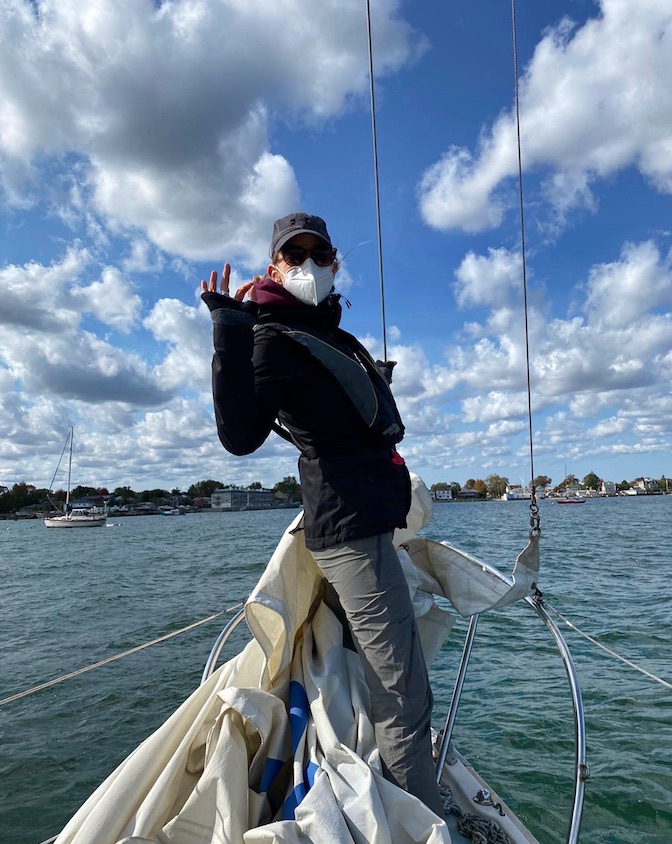
IN THAT PIC: Melody, Sunday, October 18, during a Start Cruising course (ASA 103). She did 101 with us this season as well!
It’s been a strange season, but as usual, we improvise, adapt and overcome. In March, we didn’t know if we’d have a sailing season at the Sailing Center! By June, we knew it would be closer to biz as usual on the water, in addition to our innovative and popular “Live 105” courses on Zoom for Coastal Nav (which no one else seems to be running). We figured we just had to play it safe.
We did. We limited class sizes beyond (below?) our normal capacities, further reduced classroom time for learn to sail courses, and mandated masks. Sometimes, people could take them off, but only when it made sense. Most people arrived at the Sailing Center pre-conditioned to wearing their masks all the time. (One or two prospective students were not invited to sign up after expressing a distaste or unwillingness to wear masks.)
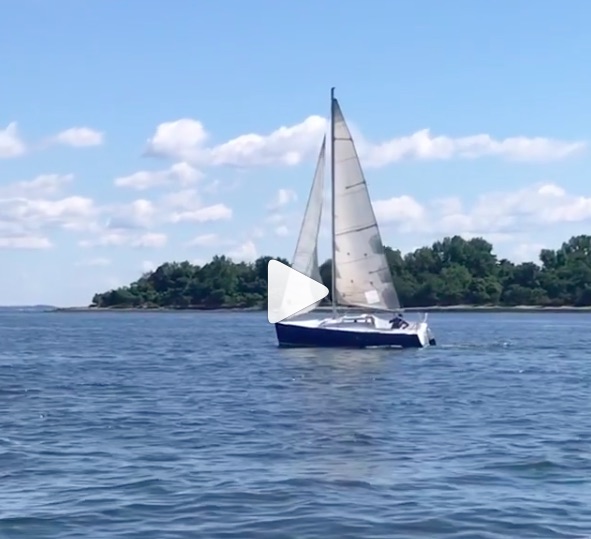
Video clip for ya ! Mike and Kelly “deal with the heel” on a windy day…
We got through the season, which is winding down. It ends by early November for us. But, the country, and much of the world, is NOT through the pandemic. Politics aside, numbers don’t lie. People lying in ICU beds in hospitals are not faking it. Many countries are in their second or third waves or spikes, and winter is coming which will almost certainly make the pandemic worse. (And don’t forget the flu!!!) A COVID-19 vaccine is not immediately around the corner, nor is worldwide distribution of it when it arrives. So… wear that mask!
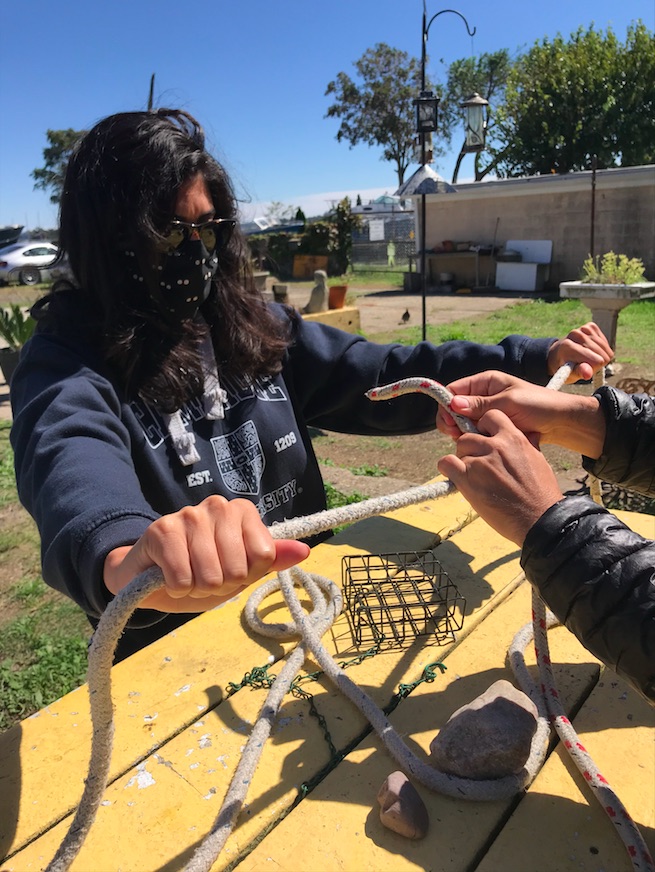
IN THAT PIC: Laura, behind all that mask and hair, joining two lines with a rolling hitch in tandem with Chris’ hands. Start Sailing, ASA 101, in September.
So…. it’s not over ’til it’s over. That sadly applies to the pandemic, but I’ll gladly take that this sailing season isn’t quite over and despite that, and eager anticipation of sliding down snow, we’re already looking forward to the next one!
The new Clinic from NY Sailing Center; it fills in the gaps left by the sailing school you went to instead of ours to learn how to sail a boat. Oops…
Years ago, we basically stopped offering rentals to the outside public, and restricted it to our own graduates. Anyone can join our Sailing Club, but before they can skipper one of the boats, they must prove they can handle it. We include one short private lesson for new members to help get them skippering.
Here’s an example: someone who joined our Club, who had 101 training and had other experience. What he didn’t do? Includes but not limited to…
Sailing a boat without an engine;
Sailing off or back onto a mooring;
Singlehanding.
So, in the clip below, you’ll see him doing the singlehanding part. roughly, but safely. We coached him through this after teaching him how to get off a mooring without a motor. When he was ready to come in, we coached him on that. Roll video:
One of our new Sailing Club members practices singlehanding, after a Beta version of our upcoming ‘102’ clinic!
So, why did we stop renting to gen-pop? They were all failing the rental checkout. Most schools had transitioned to courses that were only two days long, and it just isn’t enough. That’s a time-tested fact.
The other day, I chimed in on the ASA Private Instructors’ Forum on Facebook. (ASA is the American Sailing Association, the industry association we belong to for accreditation and certification. All legitimate schools in the US belong to ASA or US Sailing; most are ASA. ) There was a post relevant to this topic. The original poster mentioned that a school he had worked at did their learn-to-sail course in only 2 days, and he felt that 3 days was necessary. An ASA staff member commented, indicating that 3 to 4 days or sessions are typical for a proper learn to sail course. (Half day sessions can be quite productive.) I added this:
The trend toward 2-day courses has devalued the certification. I stopped renting to the general public years ago out of frustration with rental checkouts and wasted time due to this. Students who attended 3-day programs, where each day was spent mostly sailing, usually passed our checkout. NO student who did a 2-day course EVER passed our checkout. We wanted them to succeed and become rental customers. None of them passed muster. 2 days just isn’t enough, especially when the “unofficial” official industry standard is 4 per boat (we do 3 and some other schools do as well). We gave up; we don’t rent to the outside public. They can join our club program, get a free private lesson, sail with others, and be re-assessed.
Captain Stephen Glenn Card, Director and HBIC,* NY Sailing Center.
(*HBIC – Head Bozo in Charge.)
Two other members of the forum ‘liked’ my comment. No one disliked or commented on mine.
At least 2 schools in our region claim to have a 3-day course that is actually only 2 days of instruction. One does a few hours of classroom the night before the weekend of the course (after work; tired; bored after a few minutes). But, they only give 2 days of on-water instruction and sailing. Another does 2 days of mostly on-water, then lets students practice on a 3rd day. But, there’s no instruction going on after their 2-day 101.
So, where’s 102? Doesn’t exist. Not yet; not formally. But we’re going to offer a new clinic: “102: for when their 101 wasn’t enough for you.” This will be a clinic to have fun filling in the gaps left by other schools. It will be at least a day’s worth of time, probably broken up into two shorter sessions on two visits to the Sailing Center. Tuition? Not sure yet. We’ll debut it later this summer.
If you want to do it right the first time, here’s what we provide in 101:
3 full days of instruction, each mostly to entirely on the water.
2 half days of supervised and coached practice. An instructor is around the whole time, and is alongside during sail hoisting and ‘take-off’ before coaching as needed via radio and chase boat for the remainder of the practice. But, the instructor isn’t aboard. Students are sailing without one. This is the logical progression.
More time if needed for either instruction or practice. For example, if weather delays eat away too much time from a scheduled course, we simply schedule a free make-up session. If students aren’t feeling confident after the first practice, they can get more instruction for free before doing more practice. (This has NEVER happened.) If they want more supervised practice before renting or joining our Club, that’s fine – they get it. (This happens rarely; less than once per season.)
We also get people who join us for their next course, 103, after not taking 101 with us. They’re rarely ready for 103, and it becomes remedial. They weren’t done with 101!
You can pay a lot less at other schools to take their ASA 101 course. Of course, you get what you pay for. And then you pay more later. Or, you can just get it right the first time with us. Your move!
For more about our Start SailingSM 101 course, navigate your way here…
Our Director reminisces about Olympic sailing class boats he’s raced, and how it helps teach you how to sail and learn to sail better.
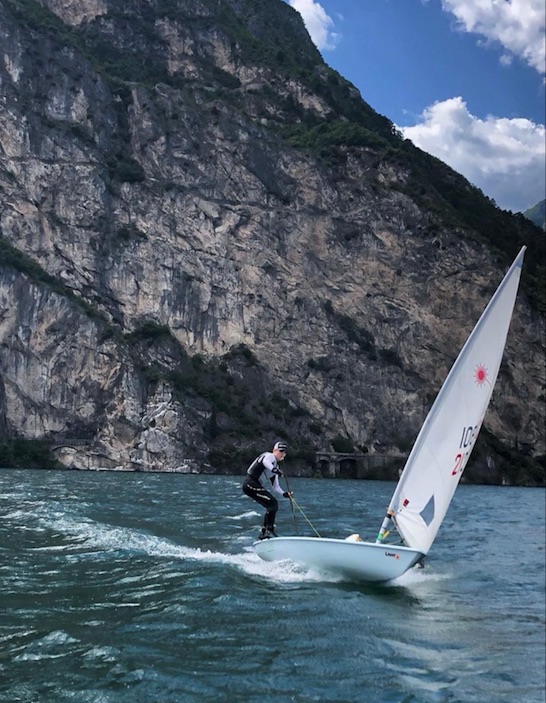
Laser dinghy, stand-up style! On Lake Garda, Italy: from Gregorio Moreschi’s Instagram.
I’ve been at this for awhile. I started sailing as a small boy aboard whatever my parents were on, and sometimes boats that just my Dad and I were aboard. We were both relative latecomers to one thing: sailing dinghies. He started WAYYY late, and I started somewhat late (at 15). Some of my fondest memories are of the two of us on separate Dyer Dhows in the Mamaroneck Frostbiting Association winter series. I sailed ‘Dyer Straits;’ he joined the next season on ‘Apocalypse Dhow.’ We had mixed race records, with a modest rate of success (i.e, staying in A Division and taking home some plaques and platter) But we hands-down had the best punny names for our Dyers.
But, I digress. Apparently, yesterday was Olympics Day! I figured it out on my Insta feed. I’ve followed Olympic sailing to some degree for decades. While I never competed at the national or world level, I did compete to one degree or another in three different Olympic classes:
Laser
Soling
Star
Sadly, I can’t find a single photo of me in any of those boats. There’s a great shot of me sitting on the rail of my capsized Laser in between races off City Island one day. In between races, one could sail by the committee boat and ask for a can of Coke. I flipped my boat so I could just relax with my feet on the daggerboard sipping my soda while others wasted energy sailing around for no reason. I won the regatta that day. I lost the photo. But, temporarily; it’s somewhere in family photo records.
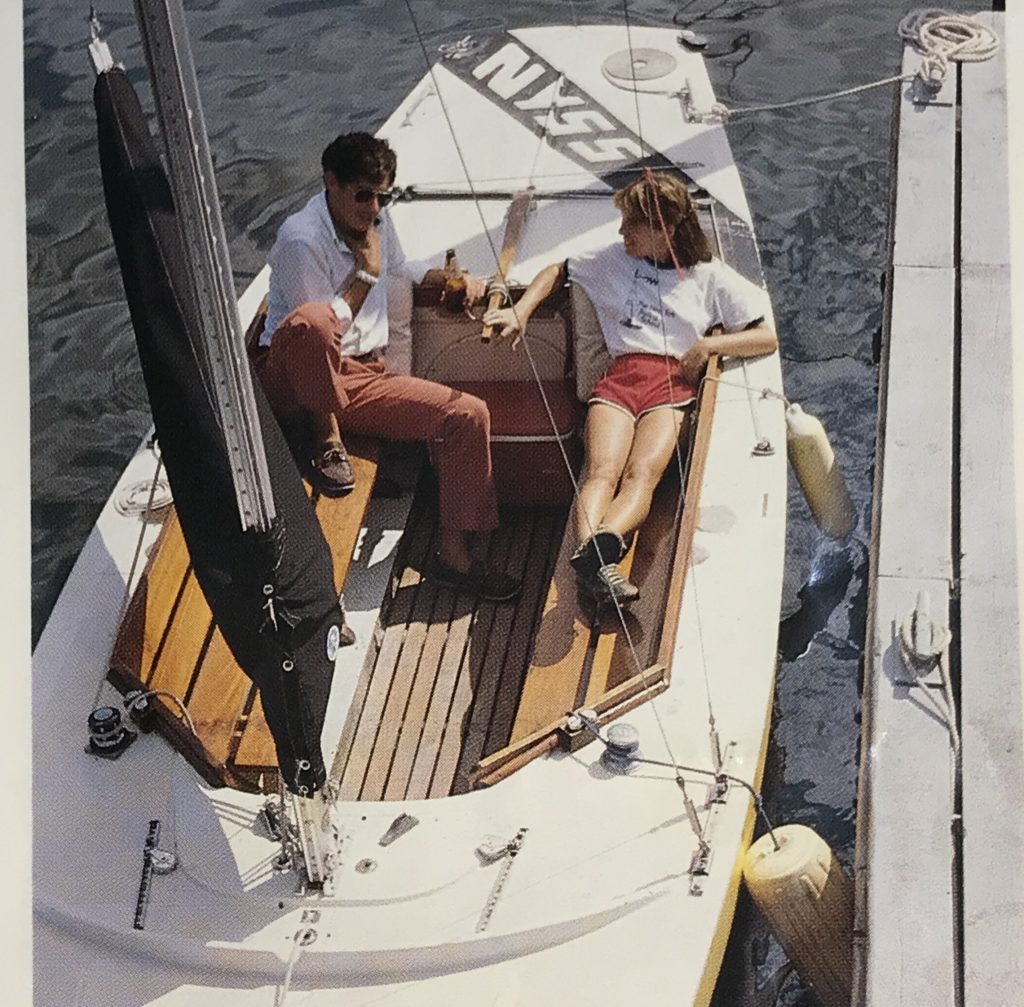
Late 1970’s; a Soling converted for sailing instruction. This was when our family owned and operated New York Sailing School. We installed custom bench seats on two of the boats to make instruction and day sailing a little easier. Harsh boat otherwise, but oh, boy – did it sail! Almost all schools eventually switched to more student-friendly designs that were more effective for instruction. Almost. (We ditched them in the early 80’s for this purpose and never looked back.)
The Soling came first, as it was the teaching boat used at our family’s first sailing school (NYSS, or New York Sailing School). Dad sold that school in the winter of 86/87, and I started mine in the fall of 1997 with classes underway in the spring of ’98.
The Soling is a truly elegant, pedigree little yacht. 27 feet of purity and grace and zero creature comforts. It’s a racing machine, straight up. Yet, it’s fun to day sail and a surprisingly good teaching boat. However, the lack of seating, lifelines, etc and the wet nature of the boat really interfered with instruction and learning. So, when Dad found a better alternative, he took that tack away from the fleet of other schools.
I mostly raced Solings at the school. We had a Tuesday night series in the summer. No, not really very competitive – but still, super instructive as it was repetitive short-course racing with tight starting lines and put a premium on tactics and boat handling. And, we used spinnakers. My favorite was a solid black chute with a stark white steer skull in the middle.
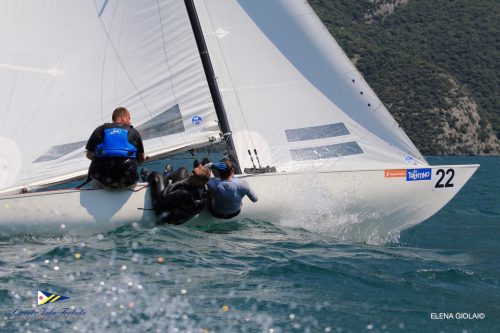
Relatively recent action on a Soling: only the skipper stays on or in the boat on a windy day! Not just a venerable Olympic class, the Soling was heavily used by adult sailing school programs across the country if not the world.
The highest level I raced a Soling? The East Coast Championships one fall out of Stamford Connecticut. I was crewing, not skippering. Perennial class champ Hans Fogh of Canada was the skipper to beat that time. We didn’t. Windy couple of days; I spent much of it hiked out over the side in the manner shown in the photo above.
The Soling was an Olympic class for quite awhile. Two veteran American racers who did well in Solings were Dave Perry and John Kostecki; Perry also excelled in the Laser. One of the best sailboat racers in history, Robert Scheidt of Brasil, won 5 Olympic medals combined in the Laser and the Star: 2 gold, 2 silver, and a bronze. Only man to win Olympic medals in both dinghy and keelboat classes. Hmmmmm….
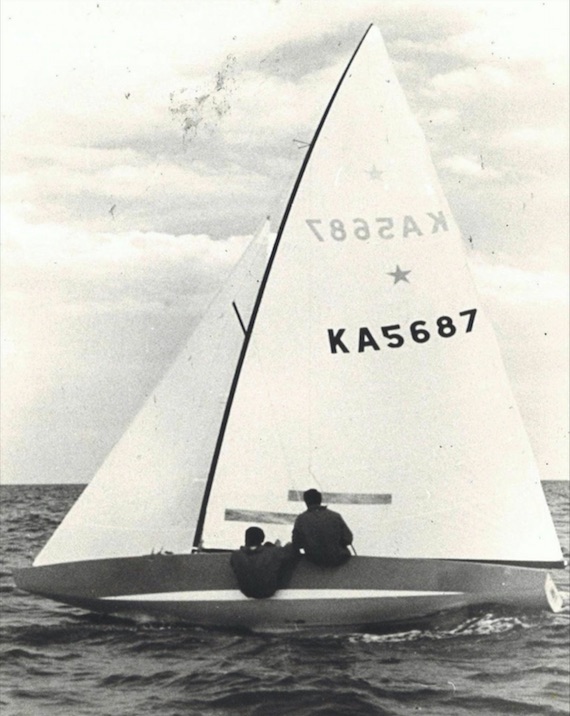
1972 Olympic Gold Medalists: Australian style! Star Class.
Then came the Star. The Stuyvesant Yacht Club on City Island, which was around from the late 1800’s, had a nice fleet of these sloops stored on trailers which they dry sailed by lowering and hoisting on a dedicated lift. I was invited to crew on a couple of occasions for Sunday afternoon racing. We had light winds, so it wasn’t too exciting – but it was fun and tactical. No spinnaker, so easier to shift gears on shifting winds in an instant and focus the whole time and tactics and strategy.
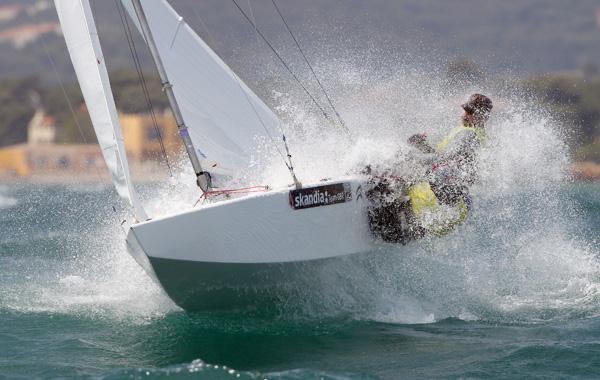
Star white room; typical recent scene for this low-riding, wet and athletic class that has seriously withstood the test of time.
The Star was in the Olympics for some time. It was the 2-person keelboat. One crew hikes over the side when needed; both sailors need to be decently sized to hold that boat down. It’s work. While no longer in the Olympics, the boat is still super competitive and used in series including the Bacardi Cup in Miami and the Star Sailors League Invitational regatta. Dennis Conner of America’s Cup fame was a world champion in the Star before he got involved in the Cup.
Next: the Laser, which came later to the Olympics but was already one of the world’s most widely sailed boats and is now the most. It’s a singlehanded performance dinghy with one sail (cat boat or uni rig), with three choices of sail size.
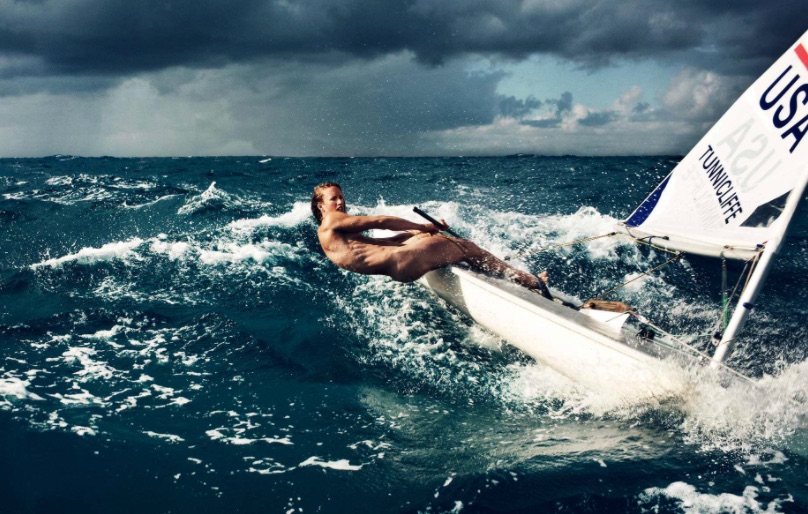
Olympic medalist Anna Tunnicliffe, from Steven Lippman’s shoot in ESPN’s In the Buff series. Note the cuts; this is an athletic boat to sail competitively.
I started sailing these in the early 1980’s and raced them for a few years in the NYC/Long Island district of the Laser Class Association. I also qualified for the Empire State Games once and drove my Laser atop my Pontiac Ventura Hatchback up to Syracuse. I was only about 118 pounds soaking wet, and raced a full rig – but as we’re in a light wind region here, I got away with it. The one time I actually won a regatta saw 15-20 with some higher gusts, but some of the better racers in that district didn’t attend. But, I sailed hard and beat larger sailors. First race: chose not to jibe on the screaming reach to the jibe mark. I did a ‘chicken jibe:’ I lowered the board, spun around in a tack, and continued. The guy I was basically fighting the whole day for 1st place? He kept it real and jibed. He flipped. I won the regatta by a hair and his capsize spelled the difference.
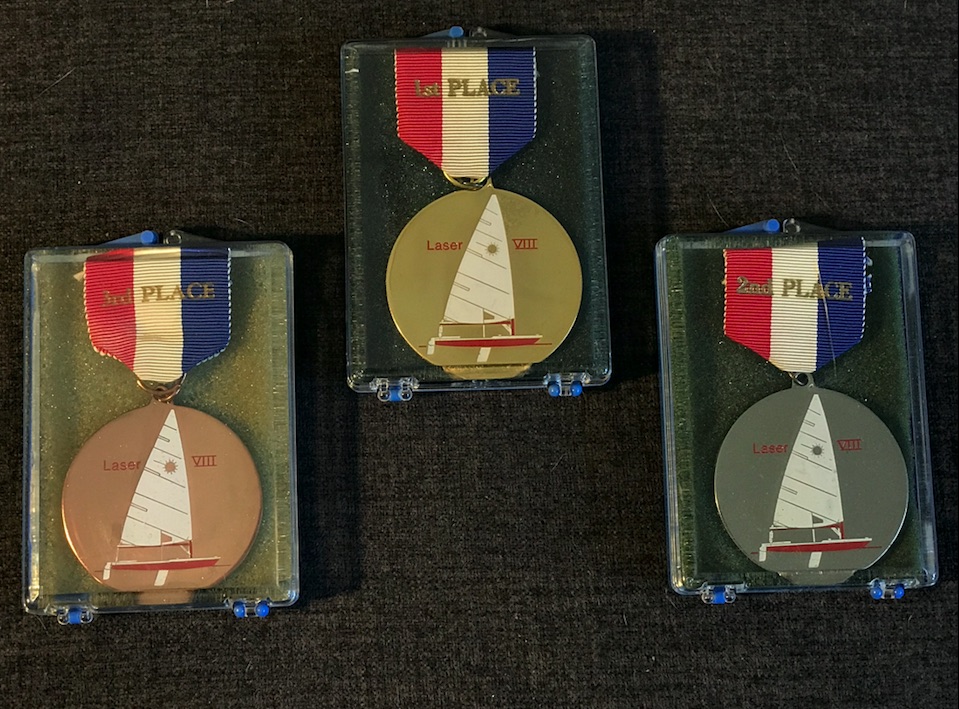
Medals in the Laser Class, District 8 (NYC/Long Island). From back in the day when our Director actively raced the world’s most popular sailboat. It’s still in the Olympics despite recent challenges by upstart imitator classes.
So, sailing on some Olympic classes paid off. First, it made me a better sailor. Second, it made me better understand how boats relate to teaching beginners and intermediates. Our family started teaching on the Olympic Soling in 1968. Since then, we’ve used three more designs for teaching beginners, in this order:
J/24, in late 70’s (immediately abandoned and returned to Solings)
Sonar in 1980 or thereabouts, continuing until NYSS sold;
Beneteau First 21 with my new school in 1998
I could have gone out and bought a fleet of Solings, Sonars, or especially J/24’s to make a cheap fleet. You get what you pay for. Spare parts for our Beneteau First 21 sloops typically exceed the purchase price of a cheap used J/24 and often that of a Sonar. I leave that for the multitudes of other schools that don’t know or don’t care.
Our Beneteau First 21 sloops have an enviable distinction: they’re the only sailboat design ever endorsed by a national sailing school organization such as ASA or US Sailing. The First 21 is the same boat as the Beneteau 22 and the ASA First 22. What’s the only difference between them? The ASA First 22 had a longer cockpit and smaller cabin. It’s the same exact hull, keel, twin rudders, mast, etc. The only real difference is the cockpit to cabin ratio. The Beneteau models have plenty of room already, so no problem there. Guess we got it right in 1998!
Here’s a couple sailing one back to our moorings on a windy day. This couple has a fair amount of experience: both raced J/24’s in NY Harbor; both sailed J/105’s. He did a Transatlantic! Also grew up cruising Maine. She did two levels of ASA courses in NY Harbor as well as an offshore delivery from Florida to New York.
Guess which Club they belong to now, and what their current favorite boat is? It’s ours – what many European sailors call the Baby Ben…
“At NY Sailing Center, we know a thing or two because we’ve sailed scores of boats, not just a few… including 3 Olympic classes.”
Captain Stephen Glenn Card, Director and HBIC (Head Bozo in Charge).
Sort of; kind of. A boat can be a small piece of real estate, but people certainly don’t have to be in each other’s laps. And, you can drive to us and avoid public transit. Which, we’re hearing, is often pretty empty. That alleviates the concern that it’s supposed to be a big petri-dish whirling cesspool of infectious spread. If we’re few and far between, we’re further from infectious.
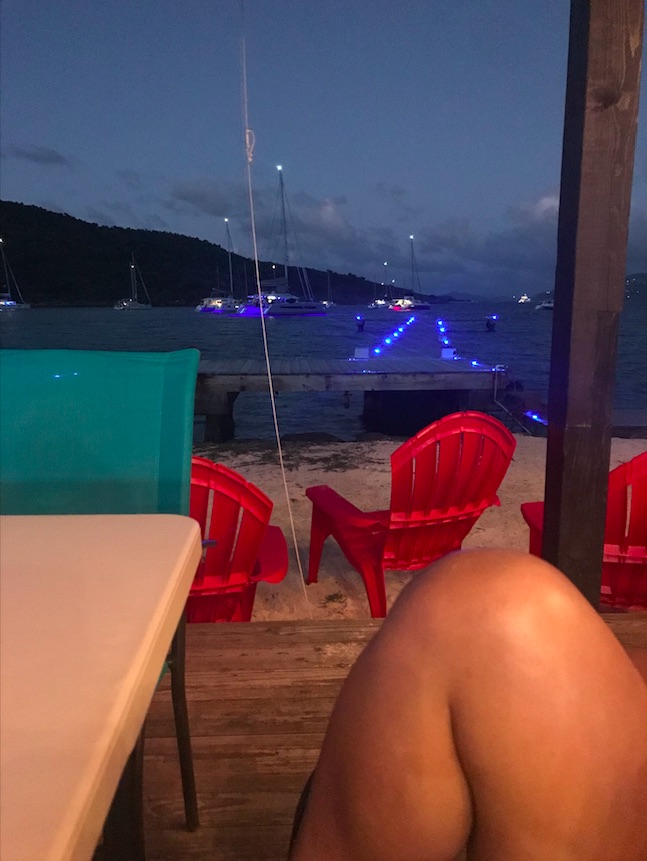
Social distance: one knee and done! We had this beach side restaurant to ourselves that night (rare occurrence, as it’s popular and excellent). The ‘runway’ is a fixed pier for larger vessels and also dinghies. Our yacht is out there somewehre! Jost Van Dyke, BVI, from our March 2020 trip.
At least out on a boat with us, or on your own if you already know how to sail, you’re doing a relatively safe, healthy, outdoor activity in the scheme of all this. Brooklyn bier gardens and rave parties: they be gone. My GF and I pretty much closed down a kewl bar we discovered on Sunday night… Bier Wax. No one’s going in no time soon now. But you should check it out when things are stable. NY Sailing Center post-virus celebration? Yup.
The exterior of Bier Wax in Brooklyn. New York brews from Brooklyn to Upstate, all surrounded by shelves of vinyl that they play. First link on their front page? “Featured DJ’s”. Turntable spinning and taps spilling. Miguel Rivas, photo, with link on their site on the gallery page.
So, what to do with the spare time? Sailing does start soon. We hope it will start on Friday, with temps at or above 70! But the updated forecast spoke of rain, wind, and maybe some thunder. We’ll have to see.
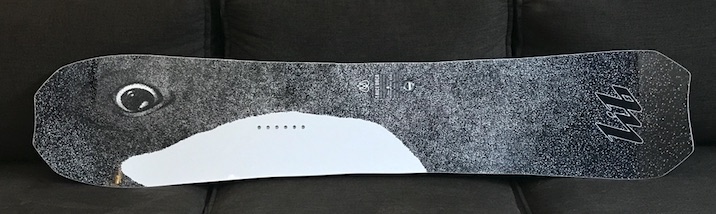
The author is a fiend for snowboarding. All the mountains closed for coronavirus. So? He sold one his boards on eBay that had proven a little too large for him. It took three auctions, including one where the buyer basically blew off the purchase. But, on the third, people being home seemed to increase viewing, bidding, and in the end, the sale price. So, there’s that!
From the eye of the Orca! Lib Tech T.Rice Orca snowboard. Super popular board that can do almost “it all.” It’s an alternative freeride board that’s excellent in powder, but it also has magnetraction edges (wavy) for solid grip on hard pack and icy snow. Short/wide/surfy style board.
Right from home, people can learn navigation. We prefer to teach that as a classroom course with practice plots in between sessions as homework. But, we have one class in progress that might switch from classroom to video conference, and we will be doing that going forward on a super flexible schedule. Let us know if you want to discuss getting in on that stay-in option!
Plot the distance… recent Start NavigatingSM course (ASA 105, Coastal Nav). Two men. Current course? Two women. We always have low class density; helps with social distancing now in the age of coronavirus. And now, we’re going remote!
Most of us are at least a little concerned about the COVID-19 coronavirus thing. Some are very stressed and panicked. We’ll get through it as a communities and countries. Some thoughts to share on prevention efforts:
Put straight isopropyl alcohol into a simple spray bottle. Boom. You have a very efficient surface and object sanitizer. The broad mist spray gets a little of it all over. In my (not so often) humble opinion, that’s all that’s needed. No need to wipe down and rub around. My GF and I came up with that; no doubt others did as well.
Re-think all brick and mortar and in-person transactions, especially paying with cash in person. I love a coffee n bagel break in my hood, but had decided to cut this out of my routine. Today, I was sorely tempted in the late afternoon. I walked over, and there was only one other customer. The staff were using gloves. I paid with singles and said to keep the change. I disinfected. I felt safe.
Be prepared to walk away from any environment when you see careless behavior or lack of adherence to suggested safe practices. See someone touching their face in the store when they’re ahead of you, or the hired help doing that (especially without gloves)? Walk away. Leave. And disinfect.
Don’t just wash your hands “for 20 seconds” and use sanitizer. Consider how thoroughly your’re actually doing it, and the order in which you’ve touched things. We wash our hands to get rid of stuff on them. So, once we’ve touched a faucet or container of liquid soap, it’s contaminated! Wash those as well. Then, wash your hands with more soap. THEN turn off the faucet. Apply that “last touch” mentality to every relevant scenario.
Exercise, eat well, and take some supplements. It can’t possibly hurt. It will boost your immune system and may well be the deciding factor as to whether you get this virus, and if so, how severely. For example, I’m taking vitamin C, zinc, and echinacea. I’ve been advised that the echinacea ought to be one week on and one off so I’m putting that into play. I’ve also ordered some bio-active silver hydrosol by Sovereign Silver based on a recco from a trusted health care professional. The list could go on as far as reccos; do what you’re comfortable with. No point in stressing over it and defeating the purpose.
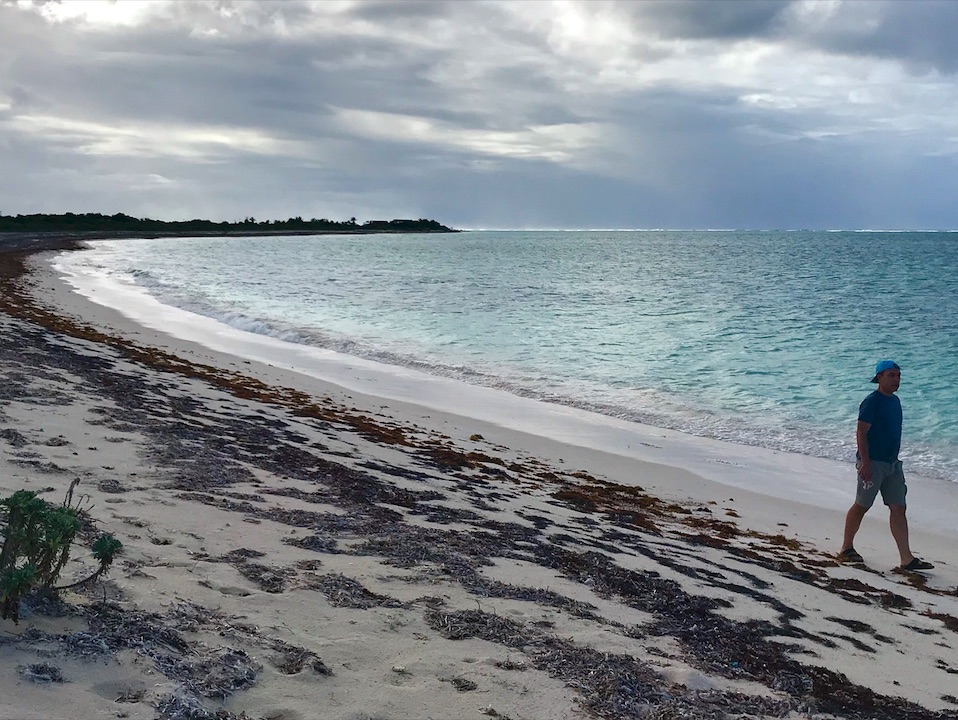
Keep your social distance – stroll alone on a deserted beach. Two other people you don’t see: me, the fotog, and Kalindi. We had a very bowl of a beach to our selves for the price of a fun bike ride. From our March 2020 BVI trip. This is on the north shore of Anegada in the late afternoon.
So… about that sailing. We got back from our March BVI trip (Virgin Islands) on the 7th as we previously wrote about. Advanced courses start in late April, and learn-to-sail in early May. Sailing Club sessions could start as early as… Friday? We shall see. But it’s coming soon!
If you join the Club, and you haven’t yet learned how to sail, we’ll find ways to get you out with us or other Club members. If you can sail, then you know how it goes.
The author, our Director and HBIC (Head Bozo in Charge) often drives out from the Upper West Side, and sometimes from Park Slope, Brooklyn. If that sounds better than public transit, he might be able to give you a ride. Of course, you’ll be asymptomatic and will have taken your temperature regularly for a few days leading up to that (and again that morning). Fever is by far the most common symptom, in the upper 80’s percentile wise. That’s why the White House had started taking temps of reporters and turning away those with spiked numbers. The second most common, in the 60’s, is a dry cough. Duane Reade was due to get more thermometers in. Find or order where you can.
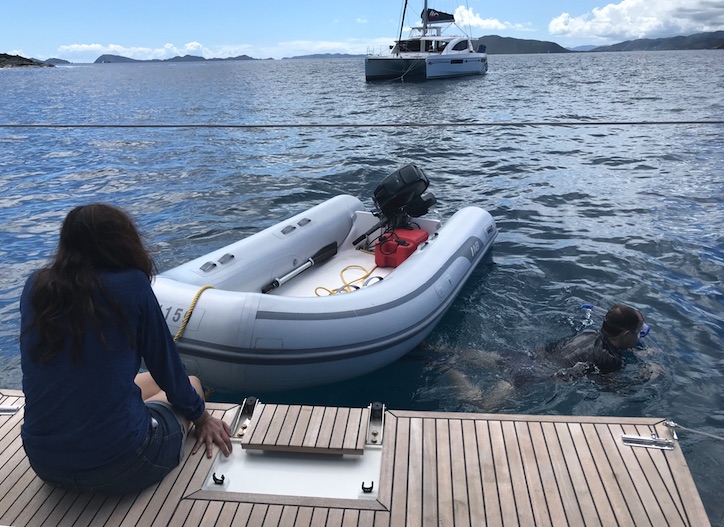
Social distancing: boats spread out (except for the harmless dinghy). People spread out. Plenty of room to breathe and roam. Quick lunch/snorkel/swim stop, first day of our March 2020 Virgin Islands (BVI) trip.
We’re all put out by this as well as freaked out. I’m a silver-lining kind of guy. I deal with the harsh reality of some things. I accept what I can’t influence or change. And, I look on the bright side. What can I do with the time I have, in the place that I am, that’s productive and maybe even makes me happy? What can I appreciate that’s different about my surroundings or microcosm of existence? There’s usually something.
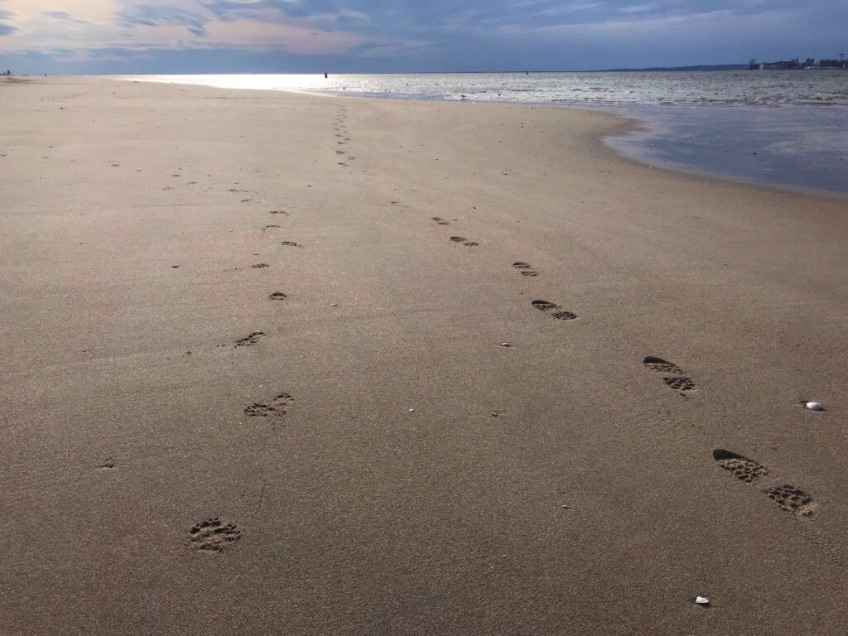
Welcome to the Irish Riviera! Dog took a walk with its human apparently. Back side of Breezy Point, Queens – the exact opposite of Montauk: The End. This is the Beginning. Great place to walk off the beaten path. The ocean side beaches had a fair amount of peeps that day, but social distancing was superb. This beach ends in a long jetty. If you go there, only walk on the dry parts. Once you see any sign of slime, DO NOT GO FURTHER. Unless you’re wearing cleats you’ll go down. Author used to rock hop out to the end wearing cleats and sporting his fly rod to catch striped bass and false albacore. It’s not for the casual caster.
If you’re not finding enough of that… come out sailing! We’ll be open soon. And we’ll keep our distance.
As we’re deep in the throes of a cold start to the winter – polar vortex/arctic blast kind of cold – thoughts are somewhat removed from sailing. But not entirely.
While on the slopes enjoying fresh pow over the holidays, and warming back up to techniques shelved during the boating season, I was reminded of the concept of turn initiation. Don’t ski or ride? Don’t even sail yet? No problem – we’ll break it all down and maybe even get you stoked in the process.
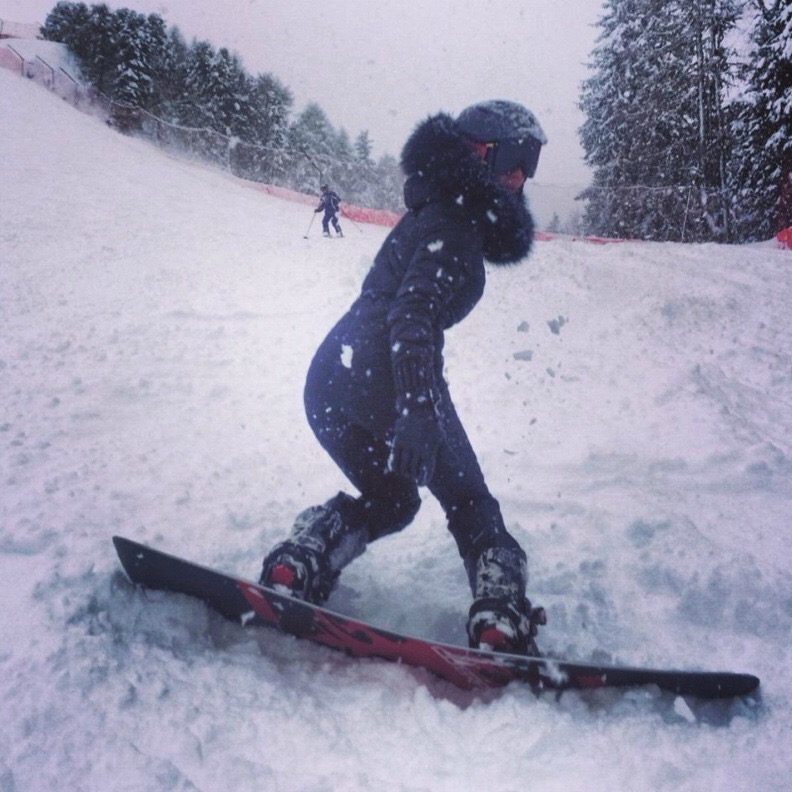
Looks like this rider either tried an abrupt start or ending her last turn that way. Wasn’t there; can’t be sure. But it looks like she made a zig-zag of quick pivot turns in a that are on the right in pic. Her edge and bottom of board are a brake right now. Good if she wanted to stop quickly. How does that translate to the rudder of a sailboat? Read on…
“Turn initiation” is the technique used to get a ski or snowboard to go from flat on the snow to beginning a turn to one side. Anyone who can link turns on either kind of plank knows what I’m talking about. It’s like this: we make certain motions to suggest to the equipment that we want to turn instead of going straight. After it starts listening, we add more motion to shape and complete the turn to the extent we want. Regardless of what kind of turn we make, we have to start it – and eventually end it.
Same with boats! Techniques, and consequences for ignoring them, are different. Thankfully for sailing, there are usual no real consequences.
If you ski or ride, but are beginner to intermediate, it’s time to think about this again as you begin your snow sliding season. You experts out there don’t think much about it, but warm up your technique and self-critique as you get your form back each season.
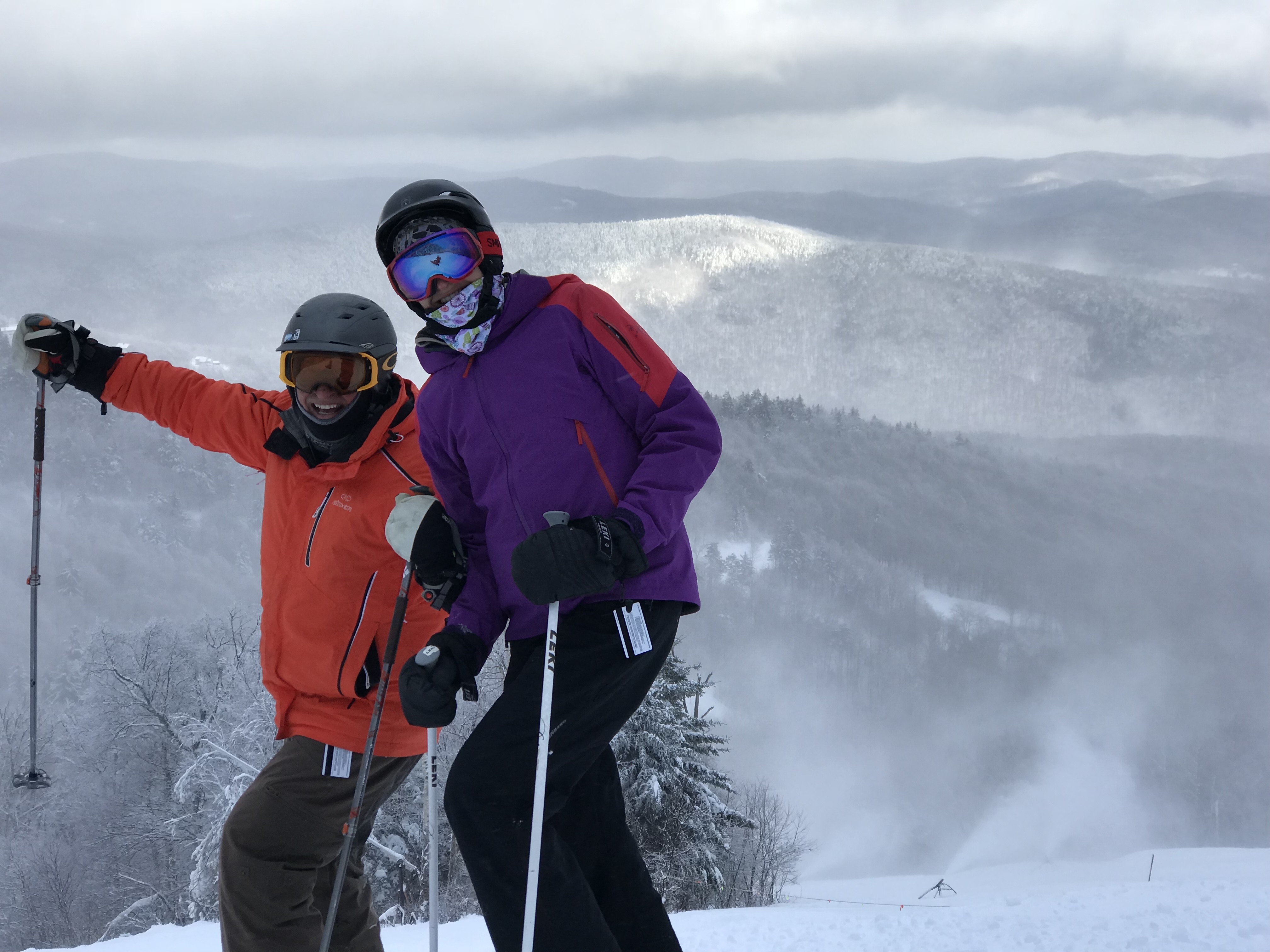
These guys are about to go down a moderately steep trail at Killington in Vermont. Skiers have two planks. Duh. Translation to sailing? Twin rudders that can operate independently. Kewl!
Back to sailing and turning a boat. Let’s leave special techniques like steering with sails, and with body weight, out of it and focus on the thing we all use all of the time: the rudder. (Don’t even sail yet? That’s the fin that we turn back in forth behind the boat to make the boat turn, like a paddle stuck in the water and angled to one side. Makes the boat turn.)
At the most basic level, we angle the rudder to one side or the other when we want to turn a boat. Some boats have a stick attached called a tiller, found on smaller boats and almost mandatory to learn with. Once the boat is in the upper 20-foot range, and especially at around 30 feet, it tends to have a wheel instead. As the rudder is angled more to one side, the pressure of the water hitting it pushes it back the other way, taking that end of the boat with it. The boat pivots in the middle, and turns. (The direction the fin aims is also where it want to go once it gets moving.)
So, to make a slight or narrow turn, the rudder does not need to angle much to the side. To make a sharp or tight turn, the rudder needs to move pretty far over. Turn initiation is really the rate of motion to get it started, so that the whole process works better.
On a board or skis, if we suddenly wrench the plank over to the side, we often catch an edge in the snow and catapult or slam. No fun. But if we get the edge to gently start engaging, and then add more edge and pressure, we can smoothly get the plank on its edge and into a turn. Can’t usually skip steps: have to START the turn before shaping and completing it, before ending it.
I haven’t skied since I as a boy, but I’ve watched a lot of skiers. Good skiers are graceful in their transitions. I’m a pretty solid boarder – somewhere in the advanced range by objective standards I’ve come across. I’ve watched a lot of boarders too. I won’t pretend I know how to turn skis. But Im supposed to be expert at understanding how to turn a board, as I’m a certified instructor. So, I’ll talk about boards.
“I PISS on snowboards and boarders!” That you? That’s fine. We’ll just shred around you and share the slopes with others.
For most turns on a snowboard – and some experts say all – we initiate by twisting the front of the board slightly so one edge is pressing into the snow and the other starting to lift. Think of holding the ends of an ice cream stick with your thumbs and forefingers. Now, think of holding one end level, but rotating or twisting the other end slightly. That’s the general idea. In the air, this does nothing but flex the stick. But on snow, one edge of that stick presses into the snow, and starts to take the rest with it to that side.
Of course, we add some at the other end, and make more of a turn. And, release. And, rinse and repeat, maybe mixing it up from time to time to not get bored.
How do we translate this to turning a sailboat?
Think of the rudder as the edge. initiation is turning the rudder ever so slightly to suggest to the boat that it should stop going straight, and to pivot. Once it listens, we gradually increase the rate of turn but angling the rudder more. But at what rate? And how far?
This is the beautiful part, elegant in its simplicity.
We slowly, steadily, move the tiller to the side. One simple, steady motion. Easy. How far? Until we like how much the boat is turning. For how long? Until we’re half way through the turn, at which point we reverse the motion at exactly the same rate.
What if we need the turn to happen quickly? Well, there is no shortcut here unless we’re throwing the boat around with our body weight, and/or using sails to help turn the boat. Again, let’s leave it at rudder only for this discussion. (And even when we’re using other techniques, rudder action doesn’t change.)
Too many sailors just jam the rudder over hard when they want to make a quick and/or large turn, especially for tacking (crossing through the wind quickly and ‘catching’ it again on the other side). Jamming it over skips the initiation. Consequences?
Drag. The rudder is now sideways to the water, creating lots braking resistance. Imagine gliding along in a canoe or kayak, and suddenly jamming the paddle in the water off the back end, with the flat side perpendicular to the direction of travel. Sea brakes! Craft slows down. Think of air brakes on a plane. Overuse them at the wrong time, and the plane starts to drop.
Stalling. Because it’s angled too aggressively to the flow of water, the water doesn’t flow around the far side of the rudder, and and bottlenecks against the near side. Water flow around the rudder allows the rudder to take the back end of the boat with it in an arcing turn, and therefore makes the front go the other way, pivoting around the middle. Stall the flow, and we stall the turn. (This also increases “leeway,” both when turning and when trying to go straight, for those with more sailing savvy. It’s why excessive rudder angle has to be dealt with one way or another when going straight.)
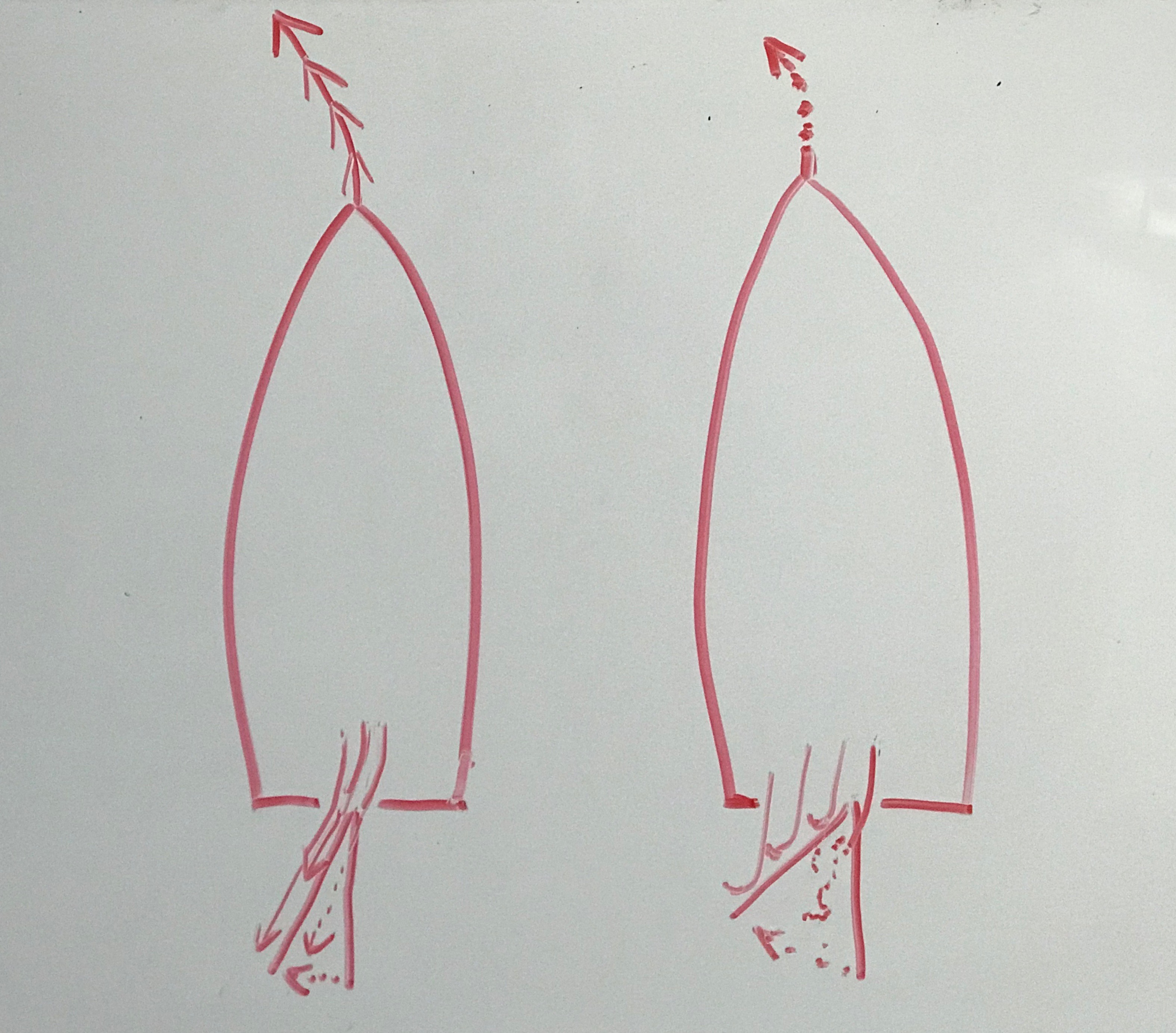
Sorry, only one color still had ink… On your left: outline of a sailboat and its rudder, shown twice – straight, and also cocked slightly to port (left). The curved lines and arrows show how the water would flow over it on both sides and allow good turn initiation. On your right: severe rudder angle typical of many sailors when they make a large turn, especially to tack (cross through the wind quickly). Arrows and squiggly lines show turbulence with little to no water flow. This is what happens if you simply jam the tiller over. What a drag…
It’s slightly counter-intuitive at first. “I want to turn hard, so why not just turn the tiller/wheel hard?” Doesn’t work that way. You’ll get there sooner by starting slower. A slow, steady, linear motion of the tiller (or wheel) gives you everything you need:
Turn initiaiton. Suggests to the boat what you want to do, and it gently begins.
Shaping. We turn the rudder enough to get the turn shape/speed we want.
Completion. So simple – half way through the arc of the turn, we just reverse what we did with the rudder at the same steady rate!
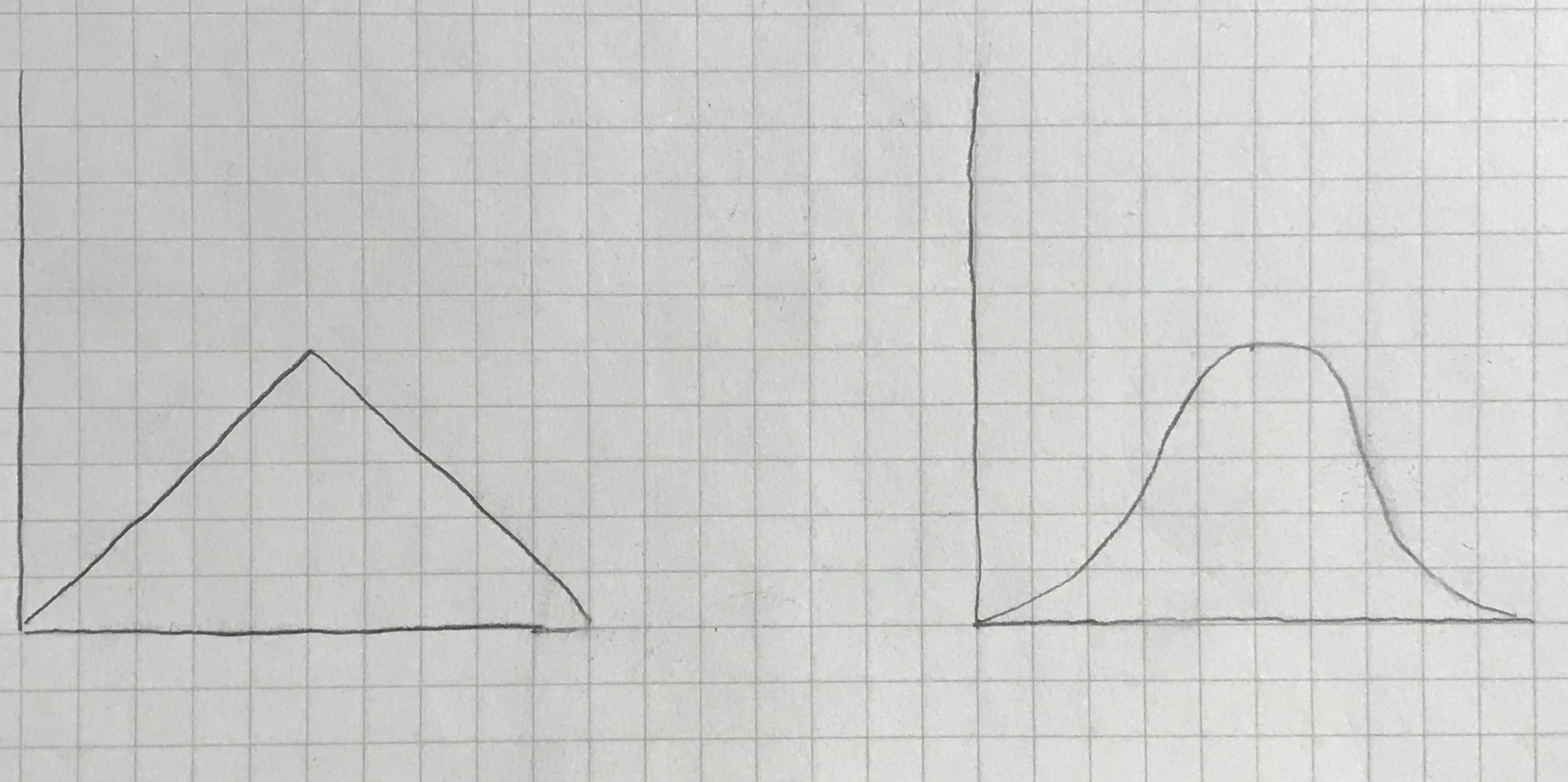
The tiller moves in a linear fashion, but the boat turns in a crescendo/decrescendo. See? We’re teaching to both logical learners and musical/rhythmic ones! If we graph it out, we’ll see different patterns for the tiller and the boat…
On your left: graph of what the tiller motion is like – linear in speed. On your right: the effect this has on both rudder angle and boat’s turn shape: good turn initiation, shaping, and completion. WooHOOO!
The more rudder angle, the greater the turn. To get there, we simply move the tiller steadily to gradually increase rudder angle, and therefore the rate of turn. Your boat will take over, and the rudder will follow. When you feel that, you’ll know you got it right.
Then, you’ll be ready to shred!
Want to learn more about turning a sailboat? See us at NY Sailing Center in the spring. We start in April.
Want to learn how to snowboard?Already ride, but want to improve or take it to the next level? Our Director, Dockmaster and rambling Editor at Large, Captain Card, is a certified snowboard instructor who loves to teach. Hit him up to discuss getting out on snow. This can be as close as Mountain Creek, NJ (an hour from the GWB), as far as South/Central Vermont, or mid way at Hunter or Windham in the Castkills.
…or is it no location? Or too many, so a school is confused about where it is?
Do two (or three) wrongs make a right (location)?
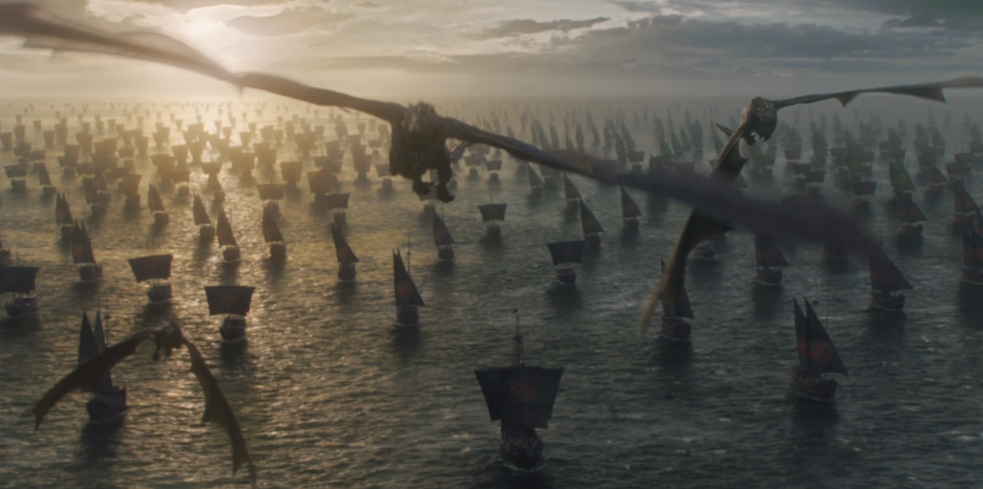
Wonder what percentage of you get the GoT reference of this post’s title. (If you don’t get GoT, let us know and we’ll bring you up to speed.)
Hint…
Wings over water – on sailboats and soaring dragons. Final scene of season six finale, Game of Thrones.
WTF am I talking about? Sailing schools who are geographically challenged and are either so confused they don’t know where they are – or want you to be so you sign up for their school at one of their dubious digs.
Example: a school is named after a geographic location. An island. They had to move from that island to a neighboring state. They still reference teaching at that original island in their blurb on the ASA School’s page. But a girl has to cross a river to get to them. (oops; there’s another GOT reference…)
Another example: a school has three locations, none far from the others (and all in our state). One moved across the bay it’s located in. Map page still shows it where it isn’t. At least it’s the right bay. One is entirely new. It’s listed on the ASA page as being in a particular Bay, where they say the sailing is Great. But a school is not in this bay. It is in another, far away, and the sailing is not in this tiny bay. A school sails in an inlet on an ocean. (And a school cannot hide from that ocean’s swells.)
What do we care? We like good old fashioned, straight up honest advertising. Plus, we’re very proud of our location. It’s extremely accessible from so many places, both by public transit and car. The area is insanely good for teaching sailing and just enjoying a day sail or a cruise.
Some schools have multiple locations. Some locations have multiple schools. Tiny little City Island, barely a mile and a half long, has historically been home to two sailing schools – sometimes just one, and for a time, three. Plus, it has two college sailing teams. Both those universities have campuses on Manhattan. But, they sail out of City Island. Finally – we have three yacht clubs on the Island and the vast majority of their members’ toys are sailboats.
We have had opportunities to add a satellite location at the “bay on the ocean,” on the Hudson, etc. We have always declined. Not worth having a location slightly more convenient to Manhattanites, or to spread ourselves around hoping to capture another demographic, just to take clients’ money and give them a piss-poor education and experience that, if they even learn properly from, they’ll soon outgrow.