Ted Turner the Sailor

This was a man who knew how to sail a boat, and he sailed a variety of them to victory.
By the way, do you still sail?

No, I’m a fly fisherman. I’m your neighbor up in Montana. When are you gonna come see me?

So began the sailing segment of Ted Turner’s appearance on Late Night with David Letterman awhile back. When? I dunno. Letterman’s YouTube Channel reposted a portion upon Turner’s passing at age 87. You can look it up based on Turner’s book that was out at the time, “Call Me Ted.”

I saw it live when it first appeared. I got all excited, because I fully expected Letterman to tell Turner he was a sailor himself. How did I know this?

David Letterman went to our sailing school in the 1970’s! No, he wasn’t as famous then – it was “Late Morning with David Letterman” at the time, but everyone knew who he was. I was a kid, but I still remember him decked out in the yellow foul weather gear we sold at cost to students for wet weather, grinning after coming in out of the elements post-class one day. But, he never brought it up in the segment. Damn…

Turner had quite a life. “My whole life has been a sea of trouble,” he quipped on the show. It wasn’t without its trials and tribulations. But it was also peppered with success. A lot of it. Most people know he started CNN, owned the Atlanta Braves, etc. Everyone knows he wasn’t afraid to speak up. But, did you know he was quite the conservationist? As the 4th largest private land owner in the country, I’m sure a good chunk of that was purchased toward that end. And, yes – I’m sure he did some fly fishing on some of that land.

IN THAT PIC: Letterman holding a photo of Turner on one of the America’s Cup boats.

Turner’s sailing career started out inauspiciously, apparently. He sailed Penguin dinghies and earned the nicknames “Turnover Turner” and “The Capsize Kid.” That means he flipped the boat a lot and wound up in the water. But, he improved. Soon, he was successful at the regional and national levels, including a hot streak at Brown University, where he captained the sailing team.

Turner put together one of the most impressive racing resumes of all time. It wasn’t how many Olympic medals he won (none, and didn’t get to the Olympics). It wasn’t the number of world championships he won (a handful; impressive of course). It was the broad spectrum of sailboats he was successful in, and the types of races he won:

  • Small dinghies (whatever he raced at Brown for example)
  • Large dinghies (Flying Dutchman world champ)
  • Small one-design keelboats (5.5 Metre Gold Cup/World Champ)
  • America’s Cup semi-one design keelboats (won one of three Cup campaigns)
  • Ocean racing: plenty of accolades here, but most impressive?

That would be the Fastnet Race of 1979. This is an annual offshore regatta off the British Isles. In ‘79, a bad storm popped up and caught the whole fleet by surprise. The goal becamse survival, and finishing the race was very optional. Fifteen sailors died in that storm. Many boats were rendered helpless. I forget what percentage of starters actually finished, but you can look that up for yourself. Two impressive finishers: John Rousmaniere, author of The Annapolis Book of Seamanship (a must-have broad-spectrum sailing reference in my not-so HO), and Ted Turner. “Captain Outrageous,” as he was sometimes called, won on corrected time in the yacht “Tenacious.”

I was in two storms that I wasn’t sure we’d make it.

-one was the NY to Hatteras, mentioned on the Letterman Segment. The other wasn’t mentioned, but was almost surely the ‘79 Fastnet.

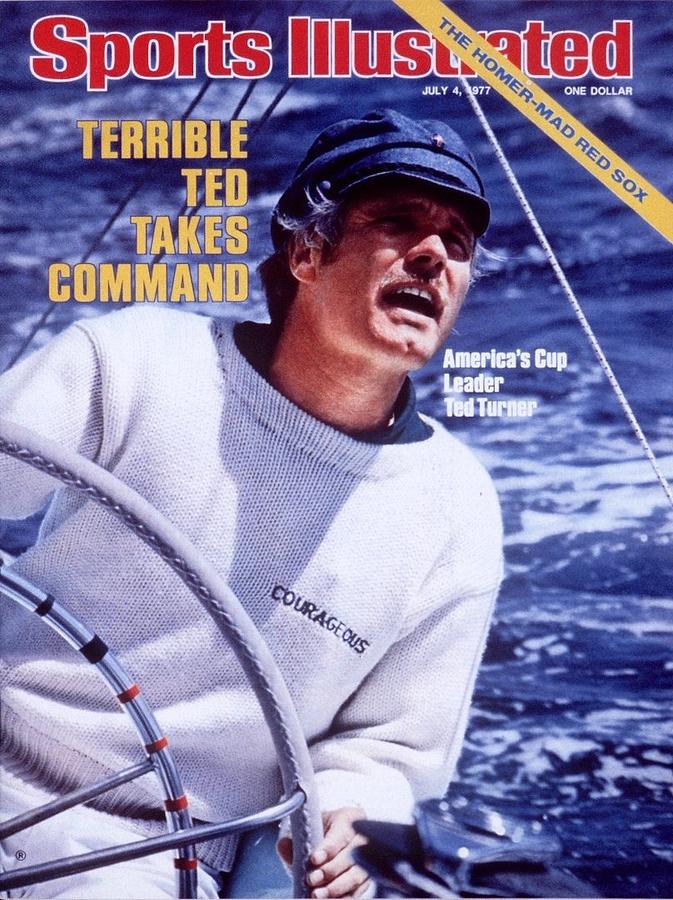
The Americas Cup is the oldest contest in the wide world of sports. Turner won in 1977, making the cover of Sports Illustrated. He competed in the trials for the Cup events before and after this one, but didn’t win. No matter. He won in ‘77, and whether it’s a tough trials, a tough Cup, or both, it’s commendable.
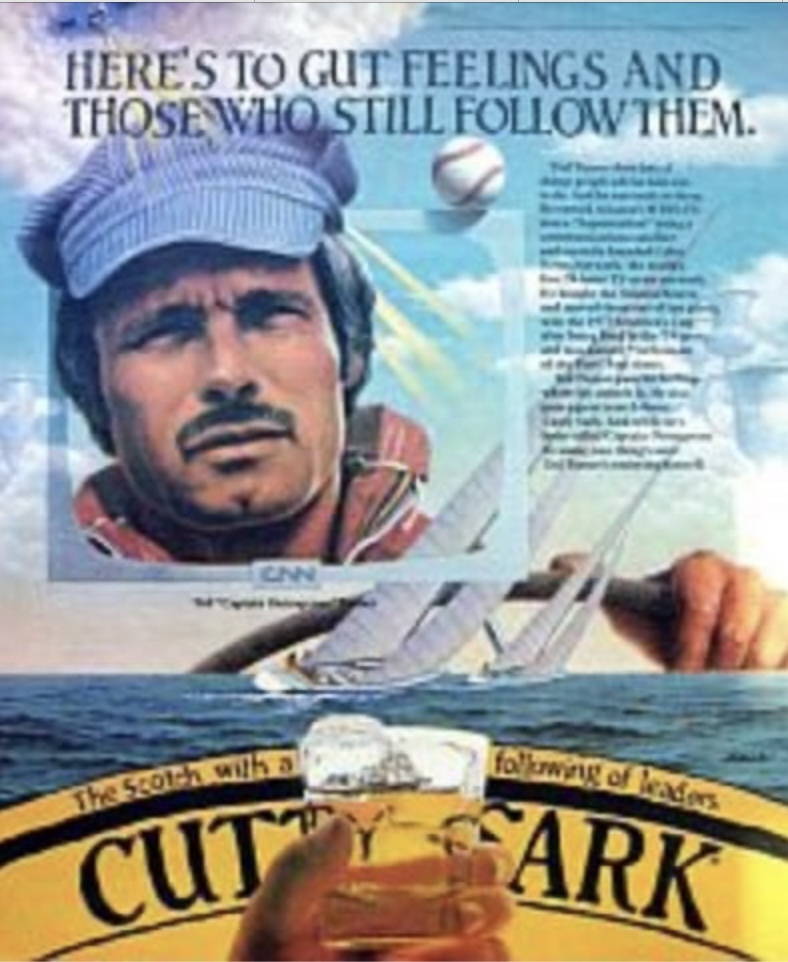
IN THAT PIC: Tuner in an old Cutty Sark scotch ad.

Fun facts:

Turner was the 2nd to last American to successfully defend the Cup after we won the inaugural event in 1858. (Dennis Connor won in 1980, and lost it in 1983, then won it back and defended it another time. “Mr. America’s Cup.”)

Turner’s boat, Courageous, was the first built of aluminum. The naval architect? Sparkman & Stephens. Turner actually bought this boat off the 1974 campaign rather than commission his own boat.

It was also one of five or so consecutive America’s cup defenders built at Minneford Yacht Yard on City Island, former home to New York Sailing Center! S&S had an office on the Island for a time; it eventually became a hybrid of cafe and diner owned and run by a lifelong friend of this author before she sold and moved on to first running and then buying/operating another eatery on the Island. There aren’t many good places to eat on City Island, despite the rep, but The Black Whale is one!

America first lost the America’s Cup the first time the defending yacht was NOT built on City Island. Waa waa.

How great and important is the America’s Cup, really?

As Turner himself said (not in these exact words), the Flying Dutchman world championship was arguably a more competitive and noteworthy accomplishment than winning the America’s Cup. The FD was also raced at the top level by folks like Buddy Melges and Paul Elvstrom – arguably the two most successful sailboat racers in history. And, Turner won the worlds once. The FD is a beast of a dinghy; it’s so large it’s hard to think of it as a dinghy. It’s 20’ long; sail plan is main, genoa (not jib), and spinnaker; crew on a trapeze. The class was in the Olympics for a very long time. (Turner competed in the US Olympic trials in the FD but didn’t get a berth.)

IN THAT PIC: not, that’s not Tuner. But, it’s a great shot of a Flying Dutchman in action and gives a sense of how hard this boat might be to sail. Can’t find a pic of Ted other than big-boat shots so this has to do for now. Photo: Flying Dutchman Class Association.

He was also world champion in the 5.5 meter (another old and very competitive class of keelboat). He won several US national championships in the Y-Flyer class, which is less well known than any of the other classes listed above, but due to its sailing qualities and ongoing popularity, was selected for the US Sailing Championship of Champions invitational regatta in both 2018 and 2024. It’s a double handed dinghy that’s more like a scow than anything else (super flat with a wide bow).

Our local sailmaker from City Island, Mark Ploch, competed in this as crew in 2018 for his daughter who was on a hot streak in college racing at the time and earned a wild card spot! Ploch (rhymes with “low”) won the j/24 North Americans once when that meant something, and sailed all manor of boats including the world’s toughest – the Finn dinghy. So, all high-pedigree/good company.
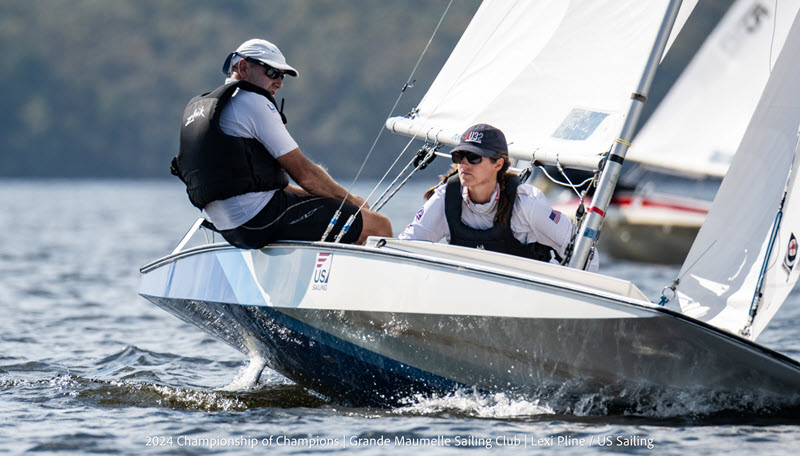
IN THAT PIC: 2024 Championship of Champions… for the 2nd time in less than a decade, in the Y Flyer class! That says something about the boat’s qualities. No, can’t find a pic of Turner in one but he won the nationals several times. Photo: US Sailing.

What’s the expression?

8 bells for Ted Turner, whose many legacies live on as a education and/or inspiration for all.
Sunny-side UP!

Sunnies (Sunfish) keep popping up in the mutual experiences of instructors, sailmakers, and students coming to us to better learn how to sail.

I wasn’t sure I’d ever wind up sailing a Sunfish… until I did. I’ve told that story before; quick recap:

But first, a pic of course…

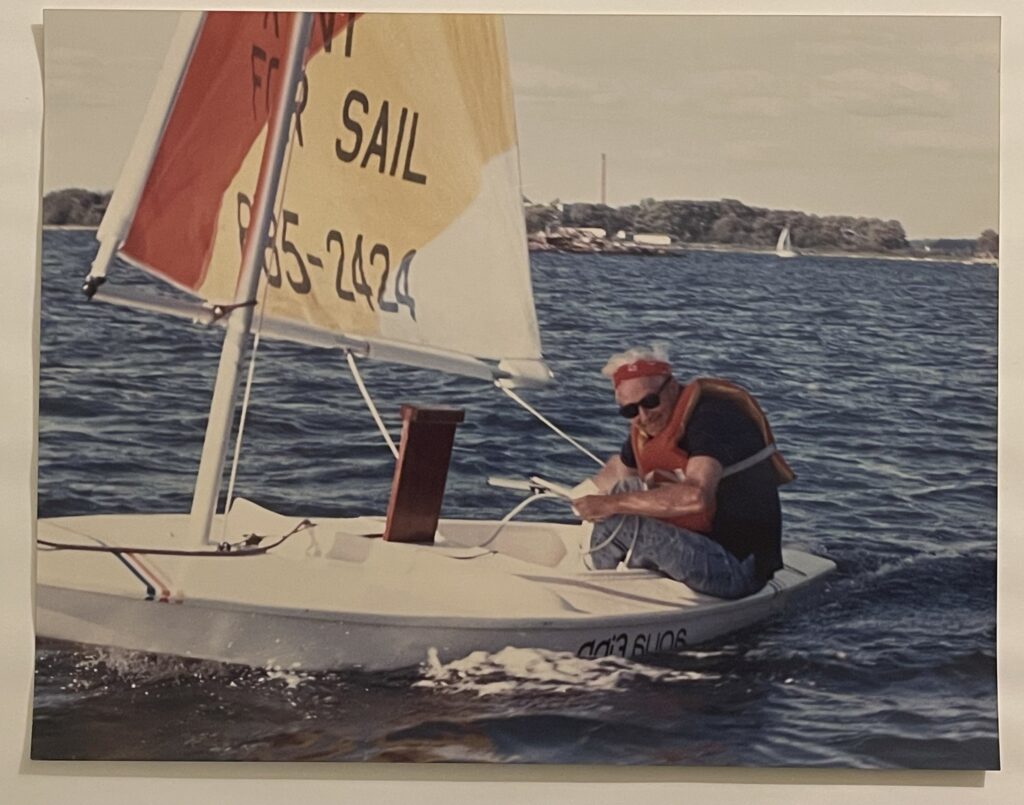
In that pic: Dad, in the early ‘90/s, sailing a Sunfish. Actually, it’s a cheap knock-off, but it’s basically the same with a smaller sail. Simple; safe; fun.

I show up for the last day of the fall series at Sebago Canoe Club two seasons ago. As I start to uncover a Laser, the gang proposes that we all sail Sunfish so it’s strictly one-design. I say sure, why not? But: caveat – I’ve never sailed one before and am therefore NOT CERTIFIED by the Club on one! (Ya know; strict rules.) Response? “You’re good.”

I was. Won the first start and led at all the marks. Good start was one thing; enough boat speed to maintain was also helpful. Of course, I pulled a WildeCard: rounded the last mark the wrong way so I was disqualified at the finish. No problem. More races to sail and fail that day and others.

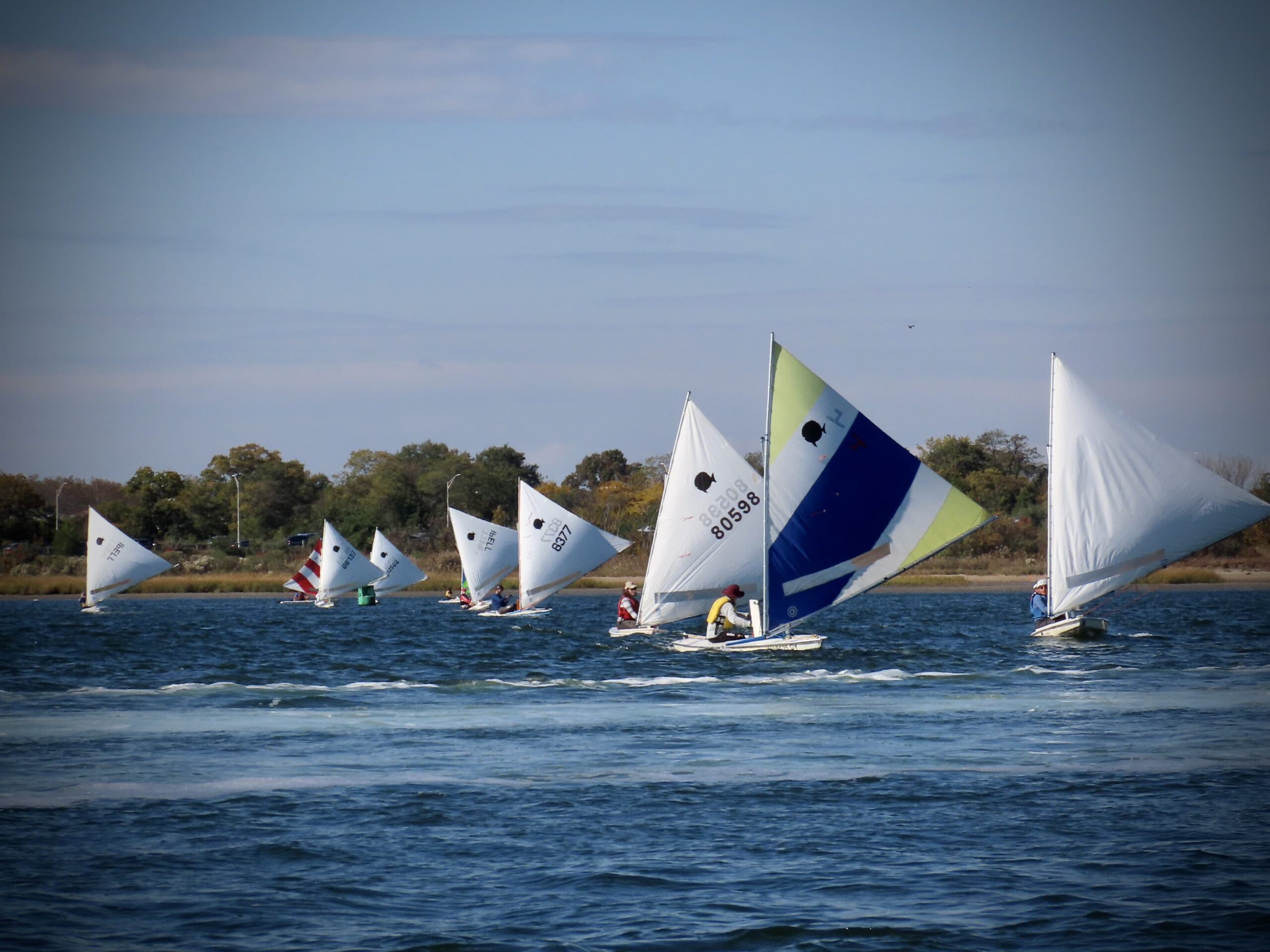
In that pic: yours truly, in the Ukraine colors, leading the fleet with a beater boat and practice (versus race) rig. First time I sailed a Sunfish, Sebago Fall Series, ‘23. We had 13 boats on the line for races that day. One or two are hiding behind others in this pic; another two or one are out of the frame. Chris Bickford, photo.

The next season: rinse and repeat. Last day of fall series. Win the start. Round first mark in 1st. Max earned an inside overlap at the bottom mark so got to round first, and he won. (I won the next; mixed bag after that including me quitting early due to light and variable winds and getting bored.)

Haven’t sailed one since. Was signed up for the 2nd annual BUSC, or Brooklyn Urban Sunfish Championship. Both this season and last, the podium was filled with non-members meaning it was competitive! This year a guy who was 9th at the North Americans, and who qualified for the upcoming World’s, won. He offered to do a clinic at our Club and the reception to that suggestion has been quite enthusiastic and grateful.

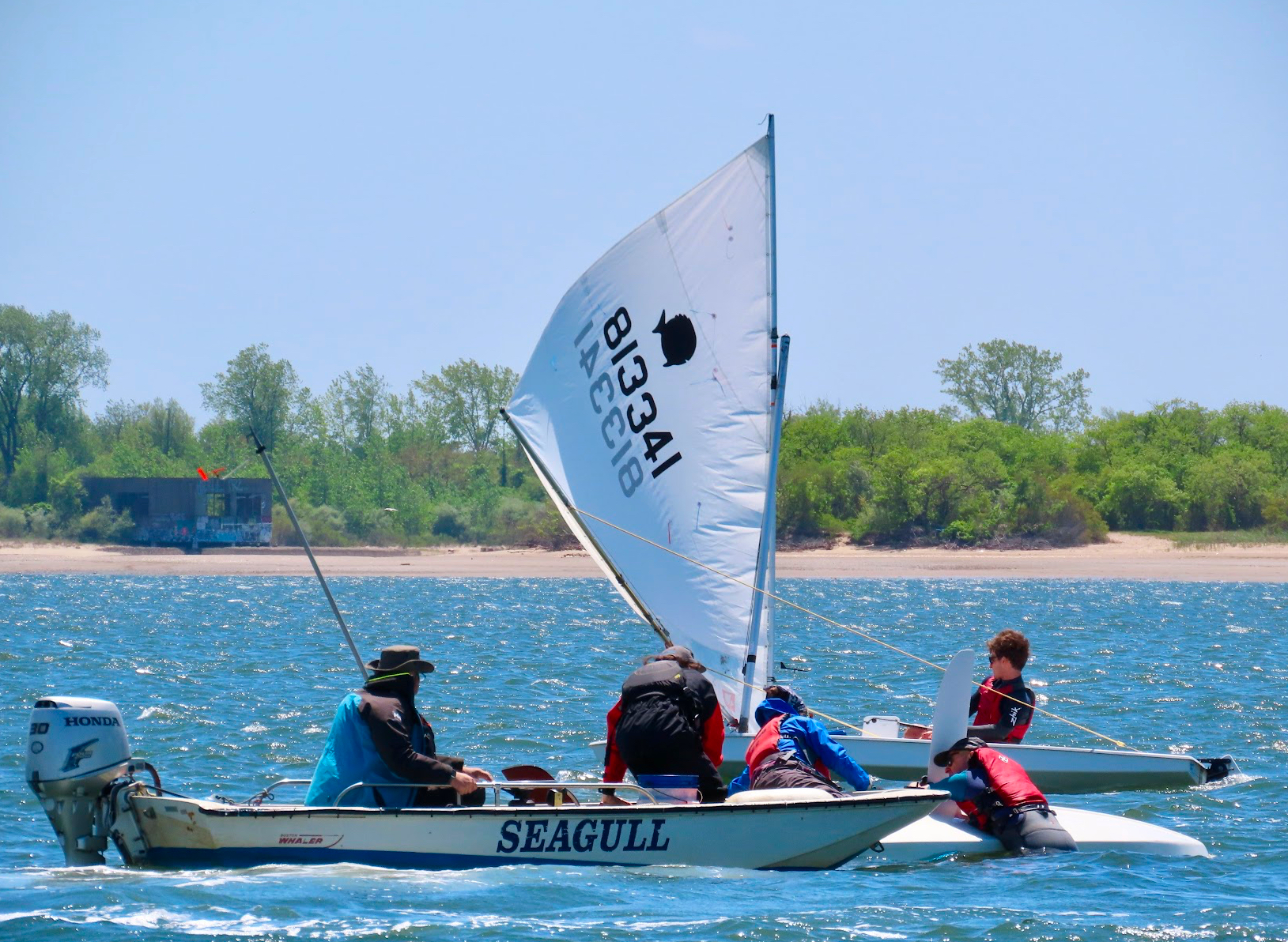
In that pic: one down, one going around, and a chase boat just-in-case boat. 2nd annual BUSC regatta, Sebago Canoe Club, spring 2025. It was blowing consistently over 20 with gusts well into the 30’s. I sat this one out.

I skipped the next date (spring series) as it was too windy for my 130-pound ass to hold the boat down. Next week? Same. Next? I was about to leave and drive over from the Sailing Center. Got the word it was canceled due to too much wind.

“So it goes.

-Kurt Vonnegut

I’ll sail them again and again, as well as a Laser and the single Vanguard 15 the club has; two members have their own so 3 is enough for some one-design fun.

Back to Sunnies. It seems that every other sailor or student I speak to lately has sailed them, and then some. So far this season, around 50% of the new students have had time on a Sunfish. So, there’s that.

I hopped on a a call with our preferred sailmaker, Mark Ploch (oh, not otch), from Northeast Sailmakers’ Doyle division in Mamaroneck. Needed to order a spare batten and pusher. Got to chatting sailing. Turns out… He learned to sail on Sunnies in Corpus Christi, Texas! He went on to other things of course, like sailing Finns (world’s toughest boat to sail), winning the j/24 North Americans once, etc, etc. But it all started on a Sunny.

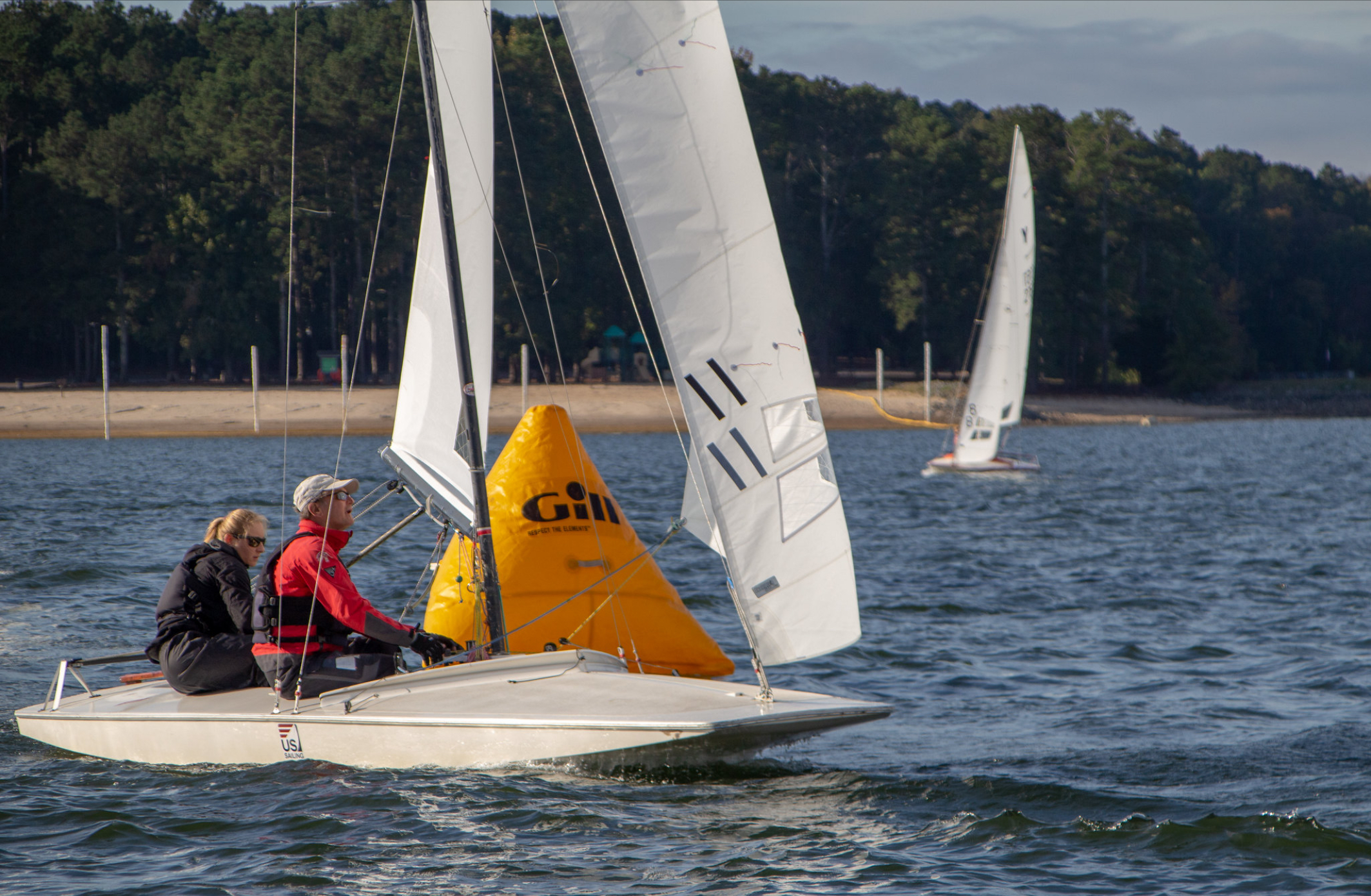
Mark Ploch crewing for his daughter, Megan Ploch, at the 2018 US Sailing Championhsip of Champions. No, this aren’t sunfish, but one can see a slight resemblance from this angle, right? Flat, hard chines, etc. These are Y Flyers, a very fast double handed sloop rigged dinghy/scow hybrid.
This is a super competitive regatta. To be considered, one must be champion at the national or world level in a well respected class of boat. One wildcard “gust skipper” is invited each year as well, based on their top tier achievements in racing. Megan was the invite that year, as she’d won the US Sailing Women’s Keelboat Championship at age 17 (a national level regatta that, like it’s dinghy equivalents, pits champion sailors from a range of different boat designs. That means it’s less about how well you know one boat and all about how well you sail and race overall. Diane Vandeputte, photo.

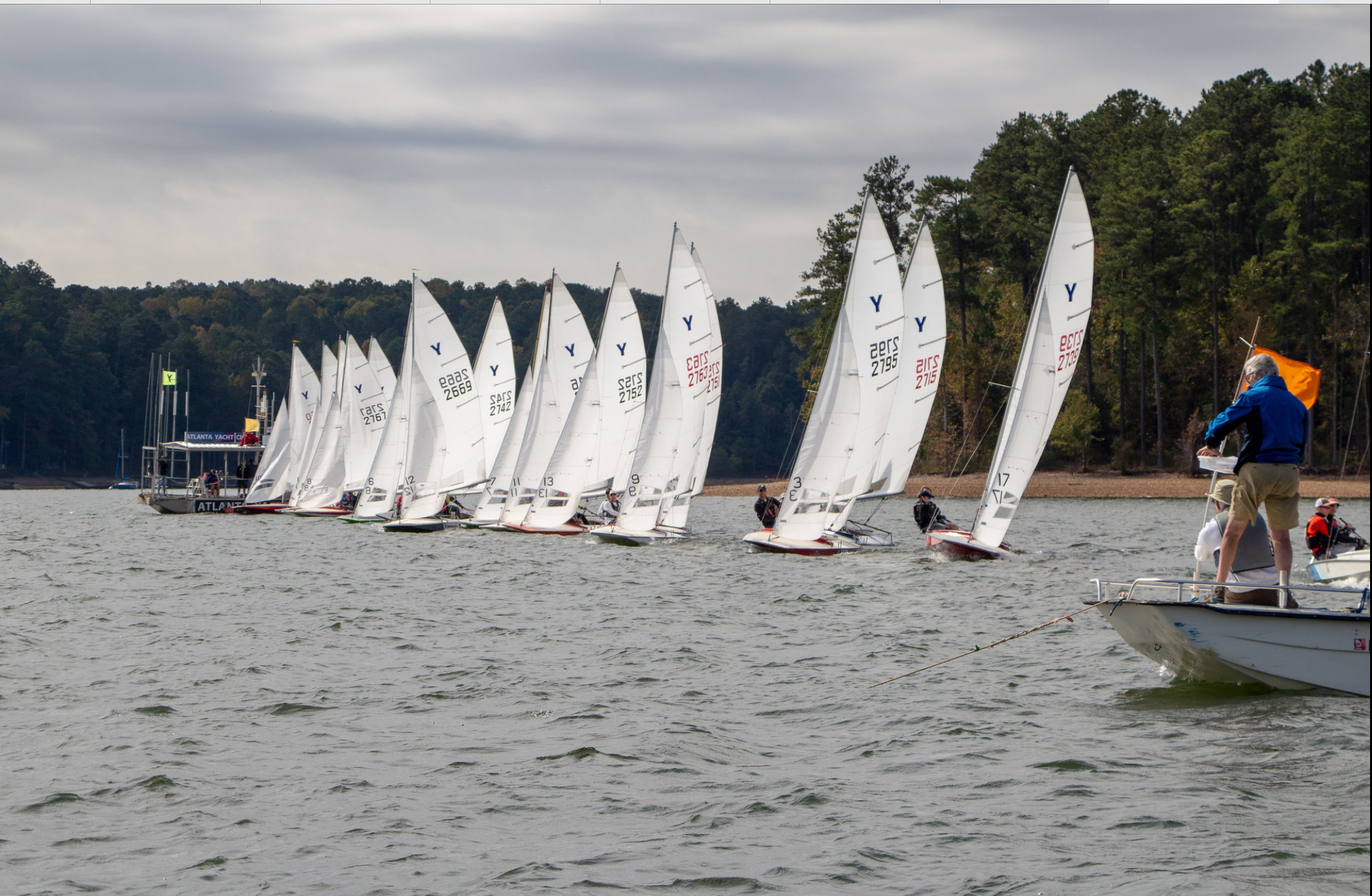
Just for better perspective, here’s a shot of a starting sequence for that regatta: this has to be 5 or fewer seconds before the start. Super tight at the windward (far) end as it’s favored (advantageous either inherently or at the moment due to a wind shift)…

In that pic: tight start in Y Flyers. US Sailing Championship of Champions, 2018. Diane Vandeputte, photo.

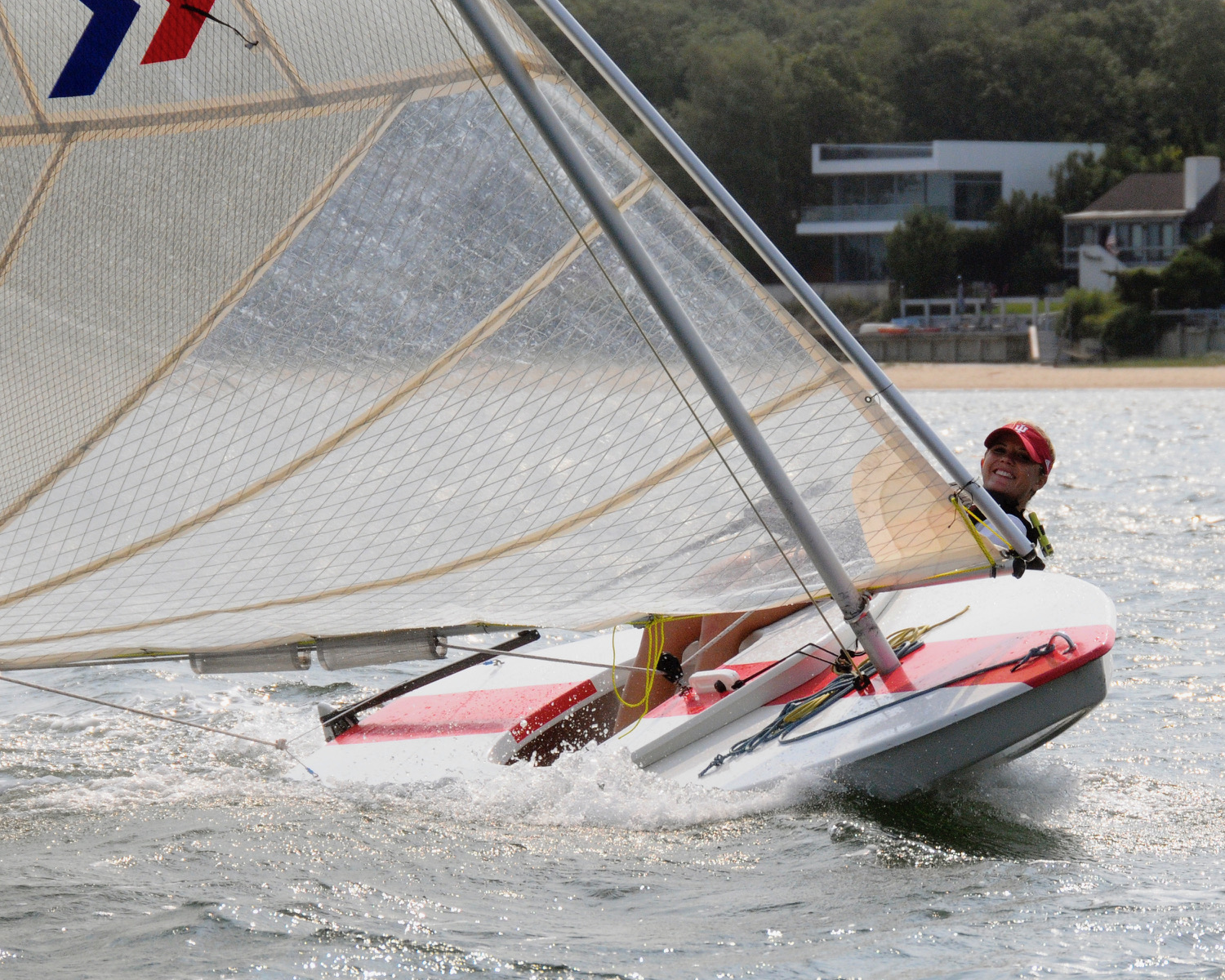
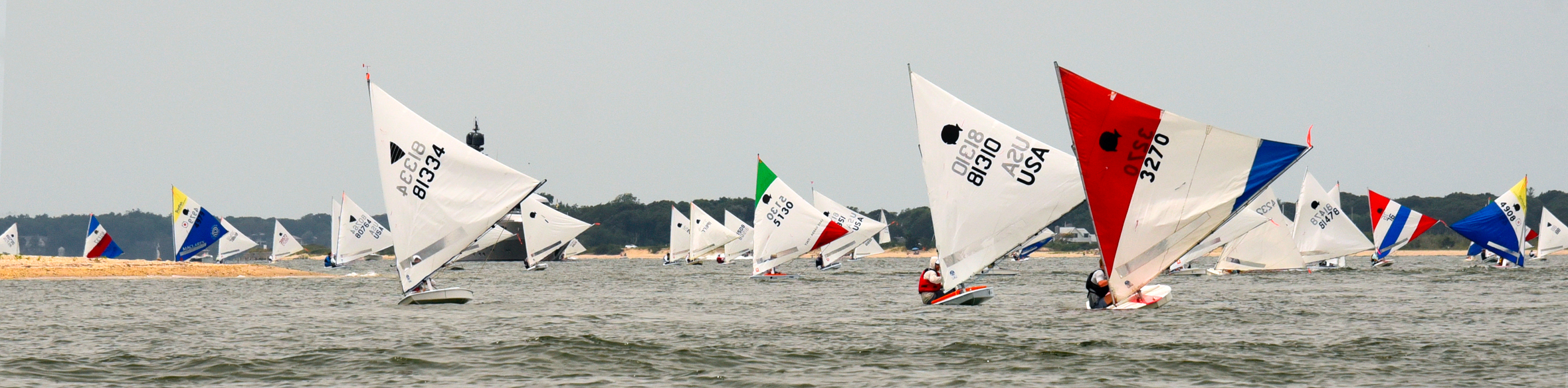
A former student of the school, Alicia, posted a pic on FB recently. It showed a Sunfish cut in half on the back of a truck somewhere. I made a quip about it in the context of my recent start in the class. Out of the blue, I then hear from Mike, a former instructor at my DAD’S school! That goes way back. I remembered Mike fondly. We started catching up on ourselves and also some of the other OG. He also pointed out that he knew Alicia, which is how he saw me pop up: he’s a photographer, and he shot the Around Shelter Island race last year. It’s a 26-mile (approx) distance race… in Sunfish! Here’s Julie Lindell, as shot by Mike, in that event…

In that pic; Julie, flying buy the fotog boat. The 2024 Around Shelter Island race, annual long-distance (over 25 miles), sailed in Sunfish. Large turnout every year and it’s full soon after it’s announced. Several members from my club, Sebago, go each year. Michael Mella Photography, East Hampton

Then, there’s Jim. He’s one of our instructors; started teaching with us last season. He knocked out his instructor certification this week. The ASA instructor evaluator (now called Master Instructors or some such) asked the candidates to chime in about their sailing backgrounds in order to best assign topics for a classroom presentation to be critiqued. What boat did Jim have time in that I didn’t know about? Sunfish! Or, at least a knock-off of one called a Phantom. (Close enough.)

Jim actually learned from us a long time and has been an avid sailor since, owning a boat or three along the way and coming along on one of our destination trips to Sicily’s Isole Eolie (Aeolian Islands). Still has the Phantom of the Sunfish.

Sunfish/Funfish. Been around since the late 1940’s; not going nowhere no time soon.

In that pic: Everything’s coming up Sunny! F-ton of Sun; one large private yacht lurking and trying to navigate around all these dinks. Around Shelter Island Race. Michael Mella Photography, East Hampton.